
Report on Participation in the “Hiking Trail Conservation Workshop”
I participated in the “Hiking Trail Conservation Workshop” organized by the Hokuto Mountain Conservation Group, which was held in Hokuto City, Yamanashi Prefecture, in July, so I’d like to share a report on my experience there.
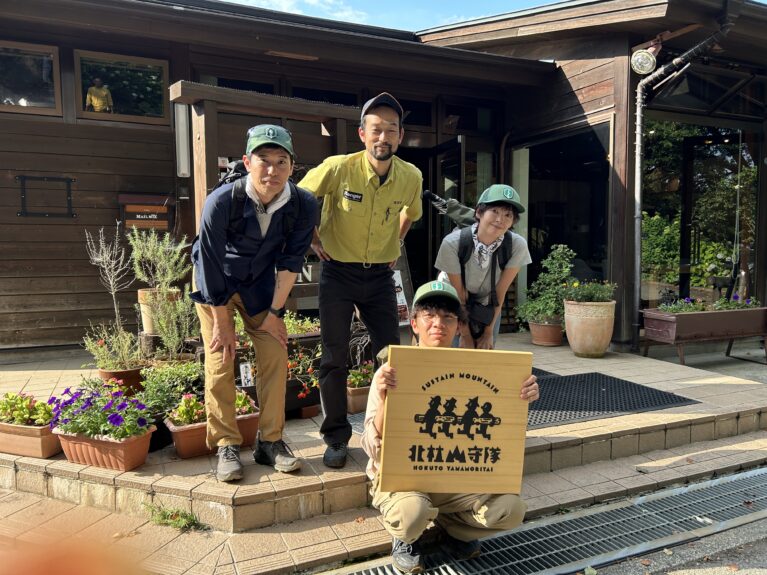
This time, three members from the Michinoku Trail Club participated: Secretary-General Aizawa, and Mori and Matsukawa from the Trail Operations Division.
Reason for Participating
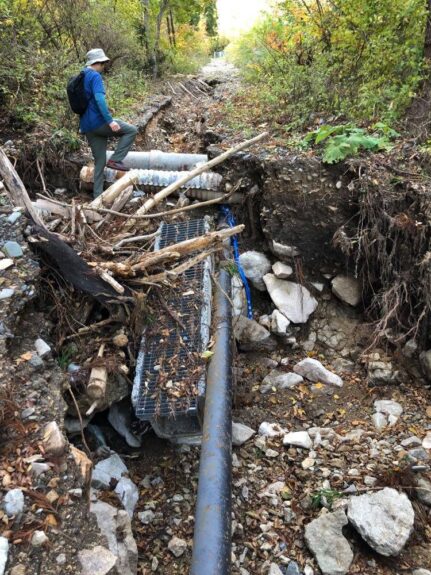
The trails we walk on every day without a second thought include many “hiking trails,” which are maintained through the ongoing cooperation of the public. At the same time, however, there are quite a few places where hiking trails have collapsed due to damage from repeated heavy rains and typhoons, as well as overuse, leading to measures such as trail closures.
The Michinoku Coastal Trail is no exception; in fact, we have observed landslides, the formation of gullies, and the deterioration of the surrounding area—as well as the creation of alternate trail routes—due to the need to detour around fallen trees. We also receive various reports and comments from hikers.
In response to this situation, the Michinoku Trail Club has begun implementing environmentally conscious, sustainable conservation efforts to improve the quality of the Michinoku Coastal Trail and ensure it remains walkable at all times—or at least easier to walk on. These are initiatives we’ve long been concerned about but have struggled to tackle until now.
However, when we first set out to begin our conservation efforts, we lacked any information whatsoever—such as why the trails become damaged in the first place, how to repair them, and how to recruit volunteers.Around that time, I heard from Mr. Takashi Katsumata—a trail expert who always offers me advice—about a “Hiking Trail Conservation Workshop” organized by the Hokuto Mountain Conservation Corps. Hoping to gain some insights into conservation efforts, I decided to attend the workshop right away.
What Is the Hokuto Mountain Guard?
The Hokuto Mountain Guardians, a general incorporated association, is an organization based in Hokuto City, Yamanashi Prefecture, that is dedicated to preserving the natural environment of the Southern Alps under the vision “Protecting Mountain Trails Together.”
Hokuto Mountain Guardians: https://hokuto-yamamoritai.org/
Mr. Hanatani, the organization’s representative director, reportedly felt compelled to take action after witnessing firsthand the deterioration of the hiking trails while managing the Shichijo Hut on Mount Kaikomagatake. It was around that time that Typhoon No. 19 in 2019 caused extensive damage to the trails, which became the catalyst for the group’s conservation efforts. Common challenges faced by hiking trails nationwide include a “shortage of volunteers” and a “lack of funding.” The Hokuto Mountain Guardians aim to resolve these issues and establish a sustainable framework for their activities by effectively combining environmental conservation with tourism. One such initiative is the “Hiking Trail Conservation Workshop.”
Overview of the “Hiking Trail Conservation Workshop”
- Workshop Title: Learn with the Hokuto Mountain Rangers! Hiking Trail Conservation Workshop (2-Day, 1-Night Course)
- Date and Time: Saturday, July 22, 2023 – Sunday, July 23, 2023
- Location: Hyugayama Hiking Trail, Hokuto City
- Organized by: Hokuto Mountain Guardians, General Incorporated Association
- Travel Planning and Operation: First Ascent Co., Ltd.
- Content:
[Day 1] Outdoor workshop (observation), indoor workshop
[Day 2] Sharing ideas, hands-on work, reflection
Details of the “Hiking Trail Conservation Workshop”
[Day 1]
On the first day, we started with an outdoor workshop.
What you actually do is “observe.”
We walked while carefully observing the terrain and reflecting on what was happening and why. As it turned out, Hokuto City had been hit by a torrential downpour just two days before this workshop, and landslides had occurred all along the Hyugayama hiking trail; we were able to see firsthand the damage caused by the trail’s recent collapse.
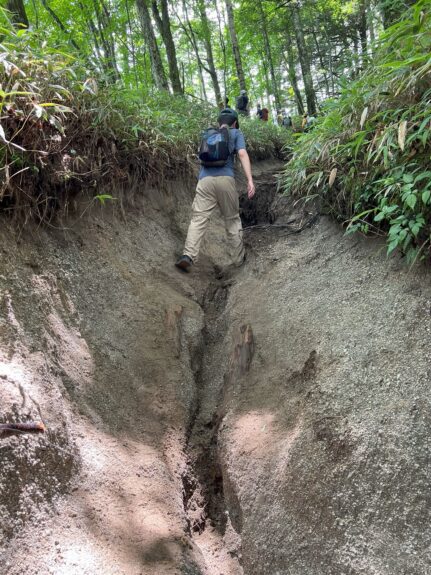
We found that there are certain patterns to erosion on hiking trails.
- Due to the pressure from hikers’ footsteps, plants can no longer grow, and the area becomes bare.
- Water collects on the trail and forms a stream. The water washes away soil and sediment.
- To avoid areas where it is difficult to walk due to sediment runoff, erosion spreads even further.
The key factors are “people” and “water.”
First, there is erosion caused by “people,” followed by erosion caused by “water.” This creates a vicious cycle in which erosion caused by “people” continues to worsen.
Conversely, if we can stop human-caused erosion from the outset, we can slow down the rate at which the hiking trails deteriorate. In the second half of the activity, in an area that was not originally a hiking trail but where erosion had begun to set in (because people had been taking shortcuts there), all participants worked together to place fallen trees and branches to create an environment that discourages people from walking there, thereby allowing the vegetation to recover.
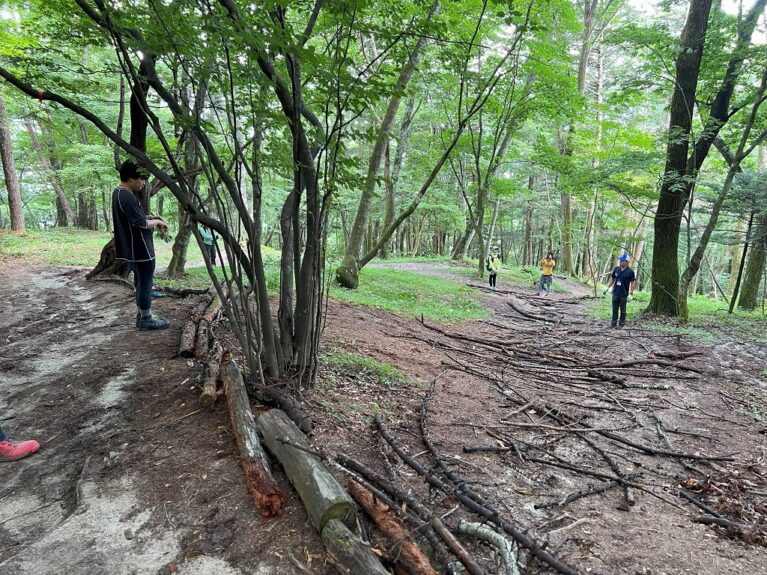
The idea is that people unconsciously tend to take the path of least resistance, so if you place obstacles to make an area difficult to walk through, they will naturally avoid entering that area. To control hikers’ behavior, it is necessary to take human psychology into account.
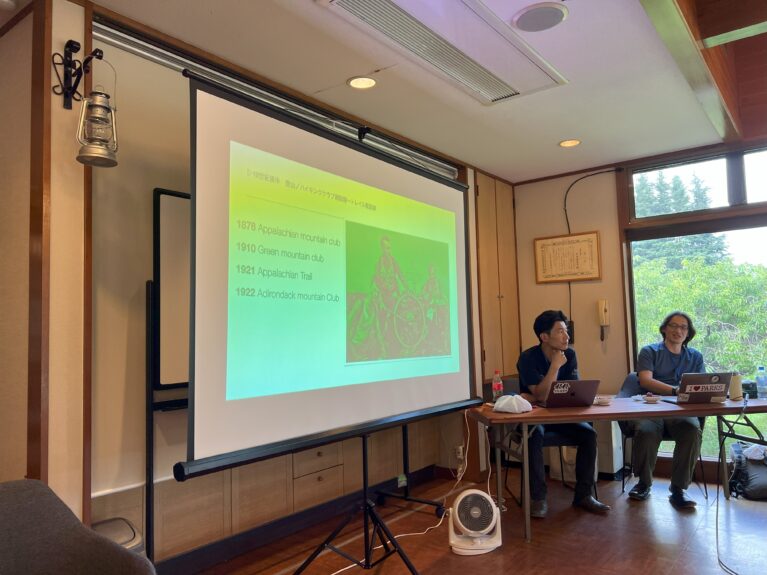
During the afternoon indoor workshop, we heard presentations on the Hokuto Mountain Conservation Corps’ projects, management systems for national parks in Japan and abroad, and the initiatives of Taiwan’s Thousand-Mile Trail Association, and engaged in an exchange of views.
[Day 2]
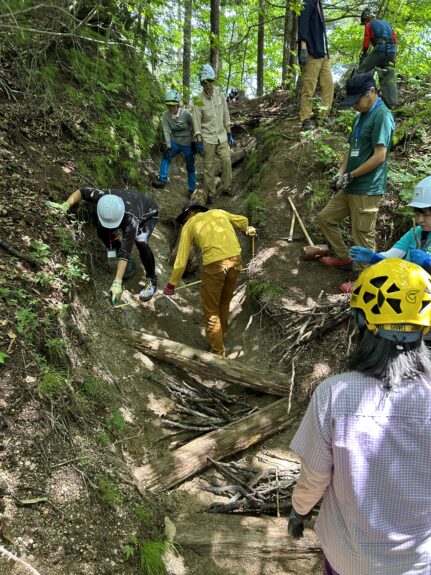
On the second day, instead of working on the originally scheduled repair sites, we ended up working at a location we had checked the previous day—where the heavy rain had rapidly caused the trail to erode into gullies. This was because people had already been walking along the side of the trail, which had become difficult to navigate, and the soil was beginning to be exposed. Based on Mr. Hanatani’s assessment that the condition would worsen if left unattended, we all climbed the trail again.
First, we received an explanation of the tools. The participants learned that they would be working with only very simple tools, but that they would also need to collaborate with “technicians”—people skilled in operating chainsaws and knowledgeable about mountain work.
First, we’ll all share our vision of what the final product will look like.
We’ll measure the overall length and depth.
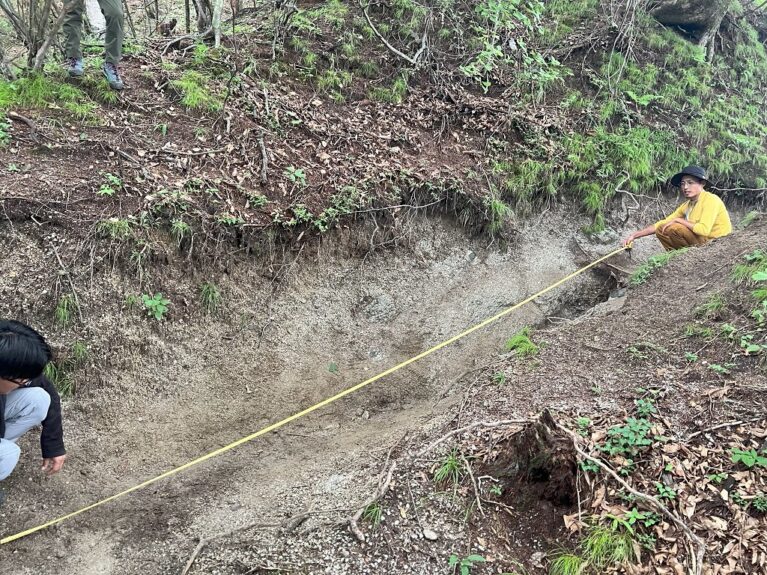
Since each step is set to a comfortable height of about 15–20 cm, once you know the total length and height, the number of steps and their placement will naturally fall into place. With twigs in hand, we all discussed where to place the steps. We were taught that it’s important to visualize the flow of water at this stage, and that a staircase with all steps arranged horizontally makes it difficult to choose your stride and thus hard to walk on. So, we arranged the twigs in a zigzag pattern.
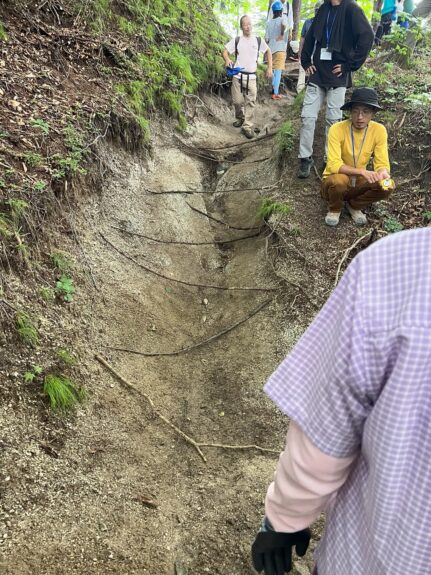
Once the location of the steps was decided, we moved on to the actual work.
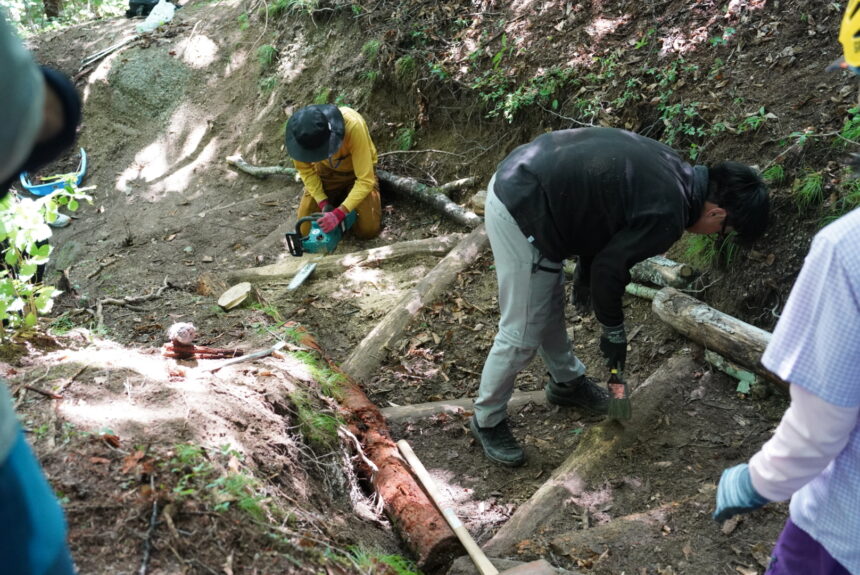
The Hokuto Mountain Conservation Team uses natural materials found on-site—such as logs, branches, fallen leaves, rocks, and soil—for restoration. First, we all went out together to gather fallen leaves, small twigs, and soil that had washed away.
The process is roughly as follows.
- Cutting Logs for Steps (Engineers)
- Installing Logs
- Collection, Transportation, and Placement of Twigs and Fallen Leaves
- Collection, Transportation, and Placement of Soil and Sand
- Finishing Touches
1. Cutting logs for steps
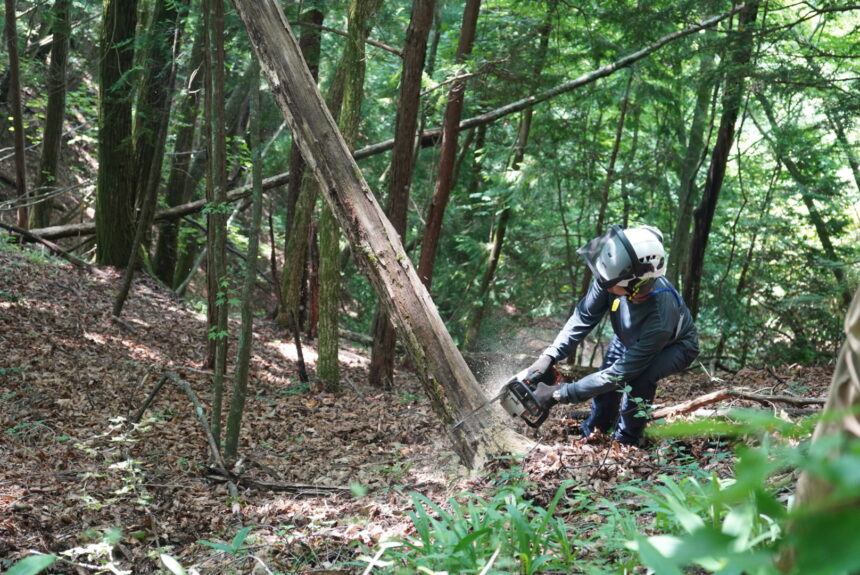
The logs used should be either fallen trees or trees that have completely died while still standing. Depending on the location, you may need to obtain permission in advance to use fallen trees.
2. Installing Logs
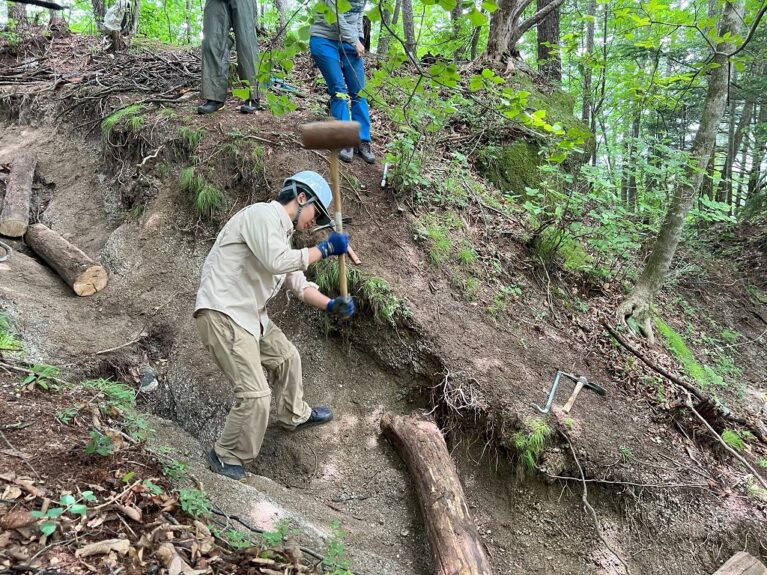
We dig a hole to fit the log into and secure it firmly with a large mallet.
3. Collection, Transportation, and Placement of Twigs and Fallen Leaves
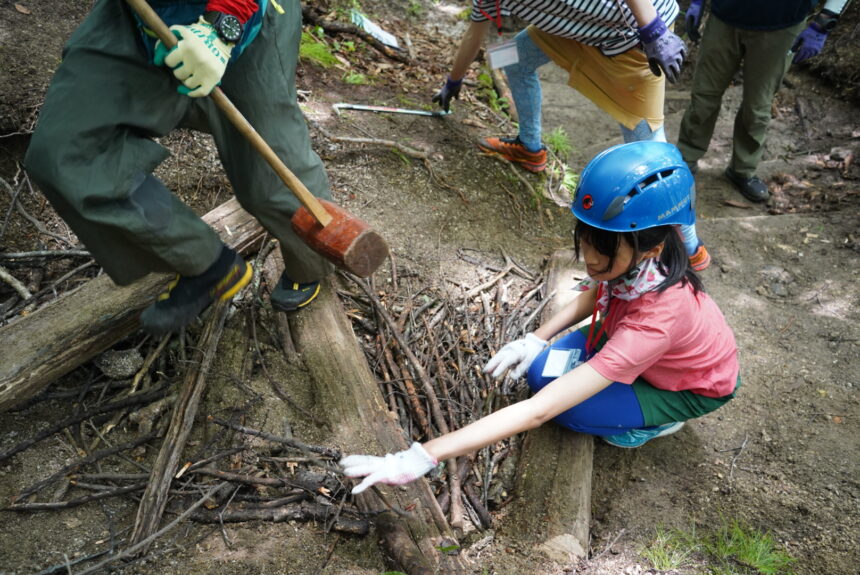
Once the logs are in place, fill in the gaps by laying small and large twigs where the steps will be.
4. Collection, Transportation, and Installation
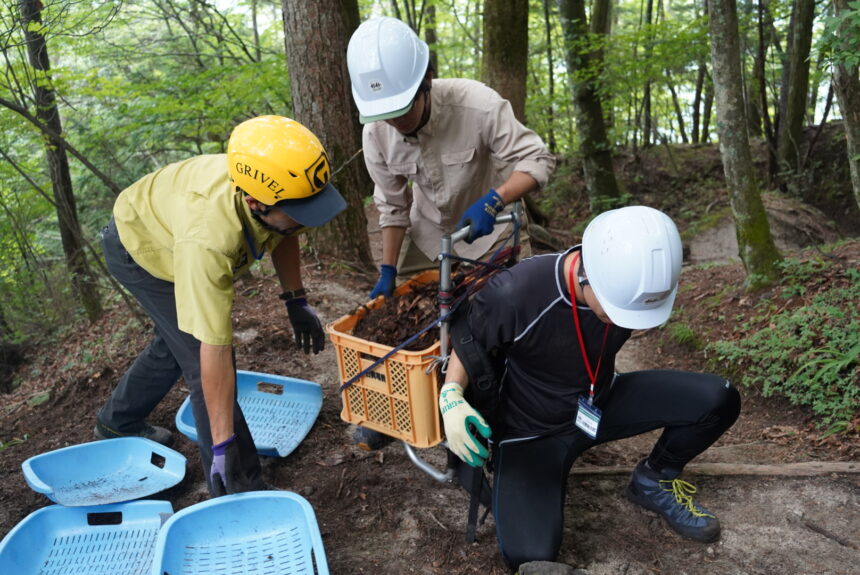
First add twigs, then dead leaves, and finally soil, and tamp it down from above. It will be loose at first, but it will become compacted as it rains or as people walk on it.
5. Finishing Touches
Once the steps are built, place thin pieces of exotic wood on both sides to prevent the soil from collapsing from either end and to stem the flow of soil on either side.
From there, simply repeat steps 1 through 5 for each step.
The key point was to arrange the steps in a zigzag pattern when viewed from above.
Placing them in this way causes the water to meander, reducing its momentum and helping to prevent soil erosion.
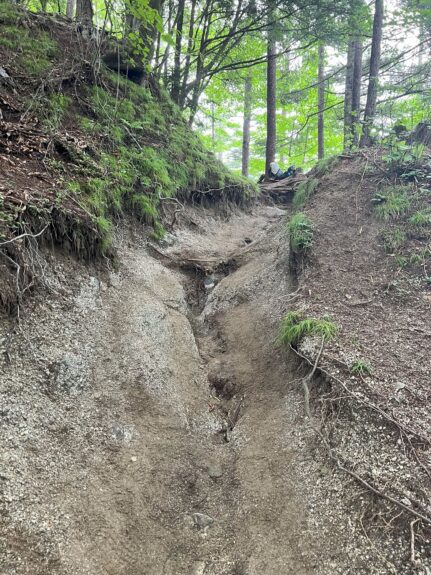
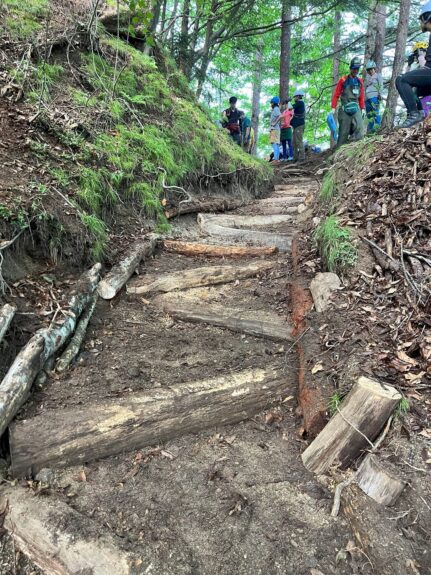
With nearly 20 people working together, we were able to see firsthand just how much the hiking trail could be restored in a single day.
By properly constructing the steps, the rate at which the trail erodes will slow down. Furthermore, it is believed that if sediment accumulates along the sides of the trail, vegetation will gradually return, which will help prevent erosion.
Reflections on My Participation and Future Prospects
When I usually hike on trails, I don’t really think much about why soil erodes or how it’s transported, but listening to the explanation while actually observing the process helped me understand the situation much better.
What I found particularly helpful was that they devoted a significant amount of time to observation and sharing their vision for the final result. Rather than jumping straight into the work, they took the time to examine the site, consider what had caused the current situation, and think about how to restore the natural environment. I felt that this process deepened my understanding of conservation.
It was incredibly rewarding to work alongside the other participants, encouraging one another and cooperating as we watched the damaged hiking trail gradually being restored. And by touching the soil and trees and taking in their scents, I developed a deep affection for the Hokuto region and its trails. Of course, “walking” the trail is fun, but “preserving” it was just as interesting and enjoyable. We’re currently planning conservation workshops along the Michinoku Coastal Trail as well. I hope we can all work together to joyfully preserve these trails for future generations.I’d like to work on establishing a system that allows all of you to join in these maintenance activities and have fun doing so. Please do join us!