

Trail Maintenance in Collaboration with CCC: Ofunato City—Ayazato Pass, Part 4
Starting in September 2025, the California Conservation Corps (CCC) came to Japan to collaborate on maintenance work along the Michinoku Coastal Trail.
https://mct-a.org/activity/10447/
In this post, I’ll provide a detailed report on “Ofunato City: Ayasazaki Pass ④” from our trail maintenance project in collaboration with CCC.
Overview
Date and Time: September 25, 2025 (Thu), September 28 (Sun), October 1(Wed)
Location: Ayasato Pass, Ofunato City
Organizer: Certified NPO Michinoku Trail Club
Co-organizer: Ofunato Regional Strategy General Incorporated Association
Supported by: NPO Shinetsu Trail Club, Oku Japan Co., Ltd., Japan Airlines Co., Ltd.
Sponsored by: Saito Confectionery Co., Ltd., Ofunato Onsen(Kairakuso Co., Ltd.)
Supported by: Ministry of the Environment, Tohoku Regional Environment Office; Iwate Prefecture; Ofunato City; Michinoku Coastal Trail Municipal Council; Sanriku Geopark Promotion Council; Sanriku Railway Co., Ltd.;Tokai Shinposha Co., Ltd., IBC Iwate Broadcasting Co., Ltd.
Participants: Hikers, local residents, local interpreters, CCC, and the individuals listed above
Details:
September 25 (Thu) Trail Survey
September 28 (Sun) Trail Maintenance (“Trail Maintenance Meeting 2025” in Ofunato)
October 1 (Wed) Trail Maintenance
What Is Ayasato Pass?
Ayasa Pass (Ayasa Kaidō) has long been an important trade route. Since it was once the only road connecting Ayasa to the neighboring village of Akasaki across the pass, many residents used it to travel back and forth. Stone monuments and ancient paths that evoke memories of those days still remain along the pass.Furthermore, the area is surrounded by lush broadleaf forests, and the beauty of the fresh greenery in spring and the autumn foliage is truly exceptional.
In 2025, a large-scale wildfire broke out in the forested areas around Ayasazaki. Driven by strong winds, the fire spread, destroying parts of the valuable vegetation, trail surfaces, and informational signs.The trail reopened on June 9, 2025, and hikers are gradually returning. Meanwhile, restoration work is still underway (as of February 2026).
Trail Survey
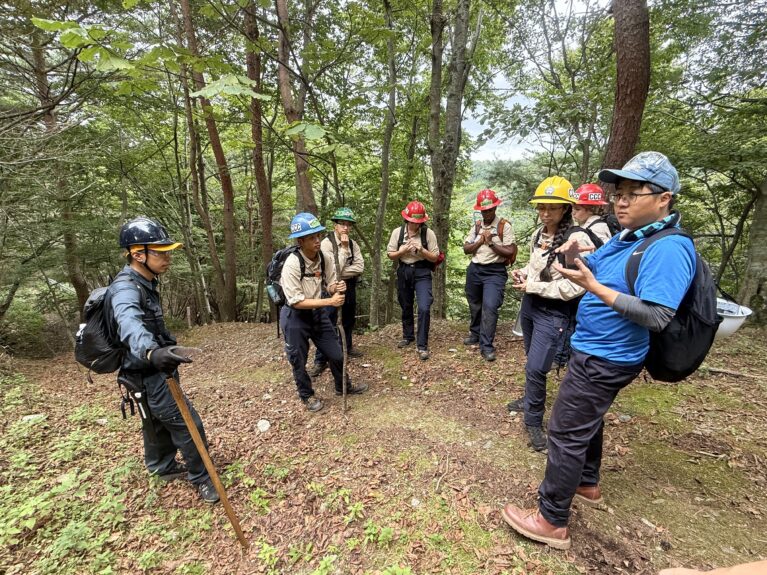
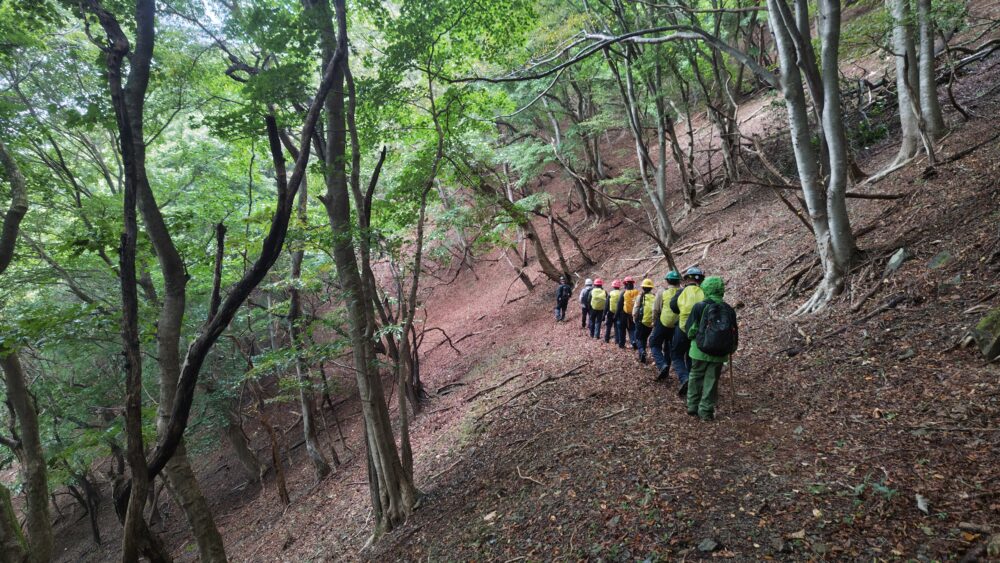
First, we surveyed the trail at Ayasato Pass together with members of the CCC.
While explaining what happened during the forest fire, we had the participants walk the entire length of Ayasato Pass.
Although half a year has passed since the fire (at the time of the survey), the scars left by the forest fire are still vividly visible.
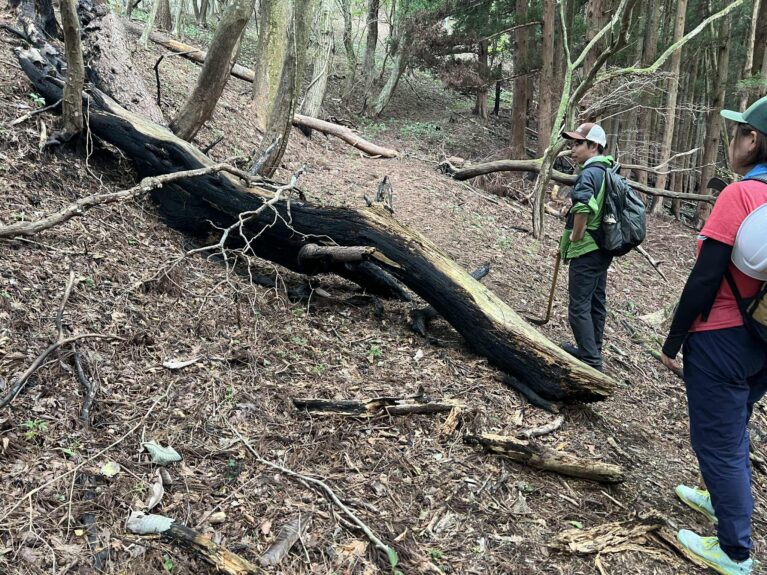
There are fallen trees and snags everywhere.
There were also many items related to hiker safety.
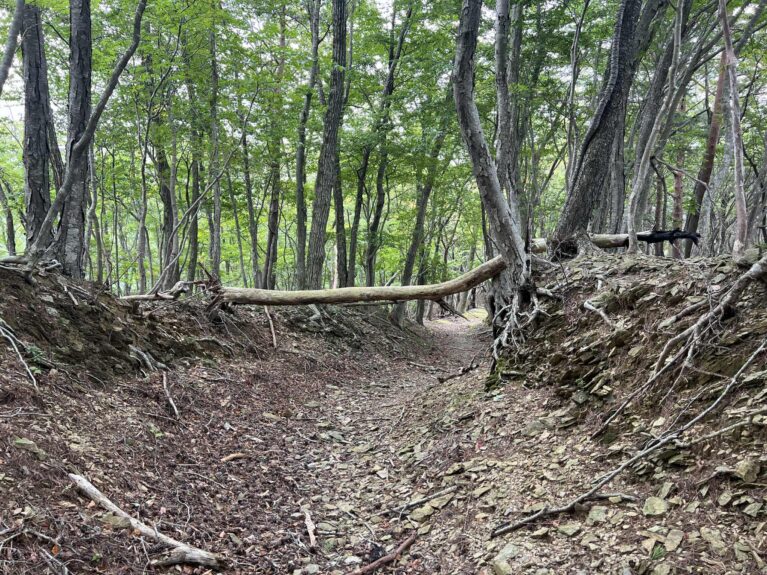
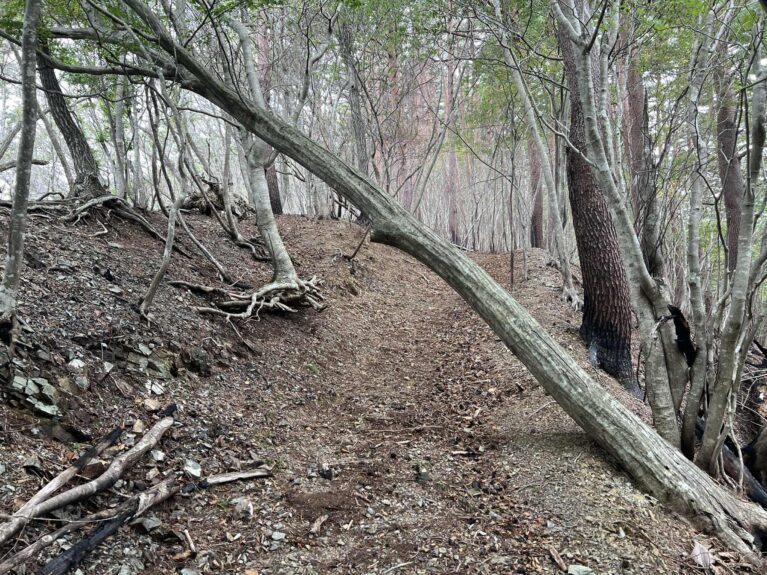
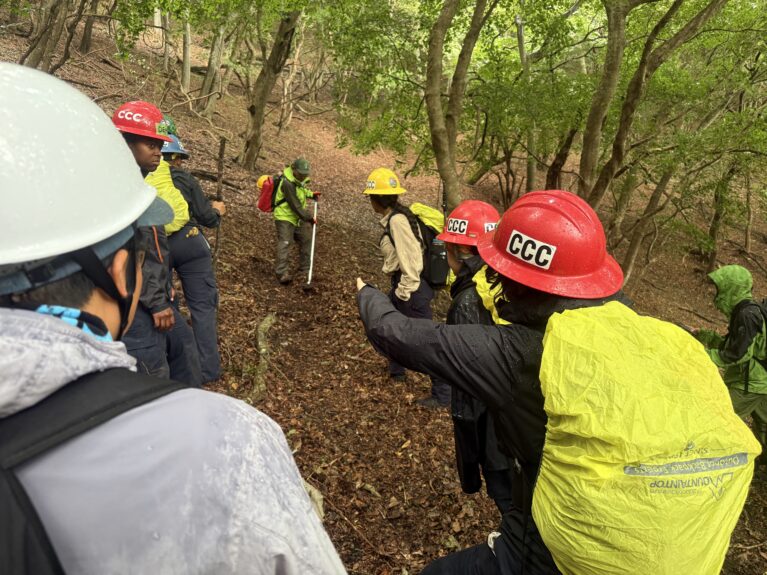
This time, we decided to focus our maintenance efforts on the area shown in the photo below.
Due to the accumulation of fallen leaves and soil, the path is difficult to follow, and the ground is unstable.
We’ll all discuss maintenance procedures together.
Trail Challenges and Maintenance Plans
This time, we decided to perform maintenance on the aforementioned location at Ayasato Pass.
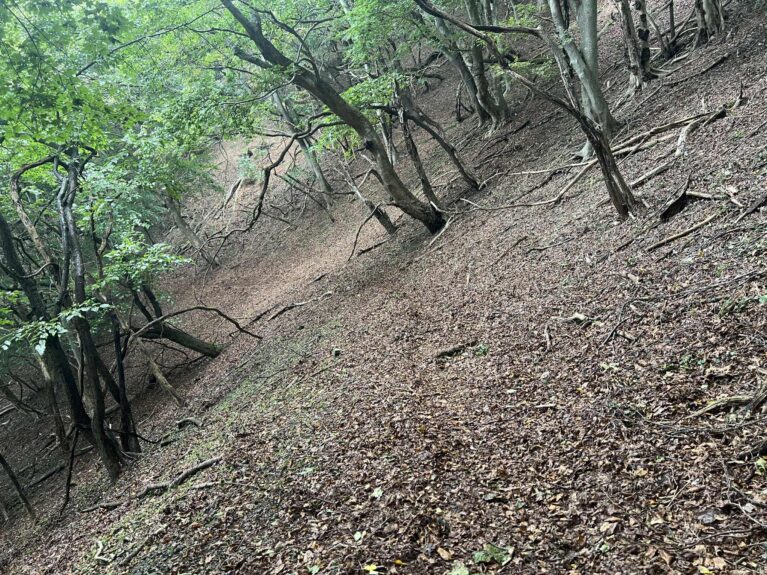
Due to years of fallen leaves and accumulated soil and debris, the trail has become difficult to follow.
An unclear trail may cause you to get lost.
In addition, since fallen leaves have accumulated up to about the shins, there is a risk of tripping over the rocks and branches beneath them and sustaining an injury.
The specific issues are summarized below.
- Fallen leaves and soil have accumulated on the trail.
- The trail surface is unpaved
- The trail itself is unclear.
We have decided to carry out maintenance in accordance with the following guidelines.
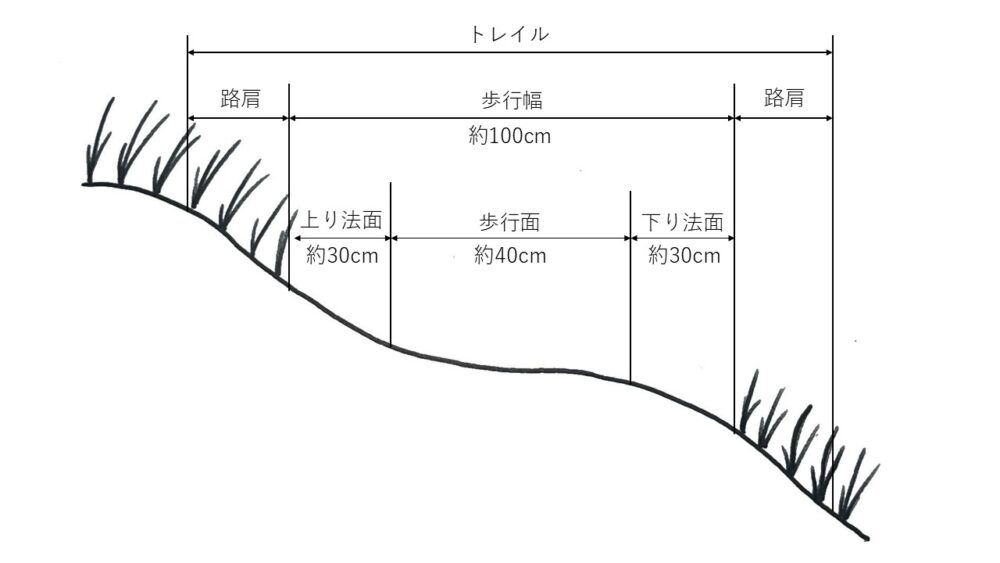
Make sure to leave a walking space of about 100 cm.
This is the minimum width required for hikers carrying backpacks to pass each other, and ensuring this width prevents them from stepping off the trail.
Next, we’ll mow the grass and trim the branches.
Since there was no grass growing at this time and the branches weren’t obstructing the trail, we didn’t take any special action.
If we were to actually carry out this work, we would mow the grass based on a walking width of approximately 100 cm (extending about 30 cm to the left and right of the walking surface).Note that we leave the vegetation on the valley-side shoulder to grow tall. Since hikers tend to veer toward the valley side and erode the “downslope” surface, allowing the vegetation on the valley-side shoulder to grow tall helps keep hikers within the trail, thereby ensuring the safety of both the vegetation and the hikers.
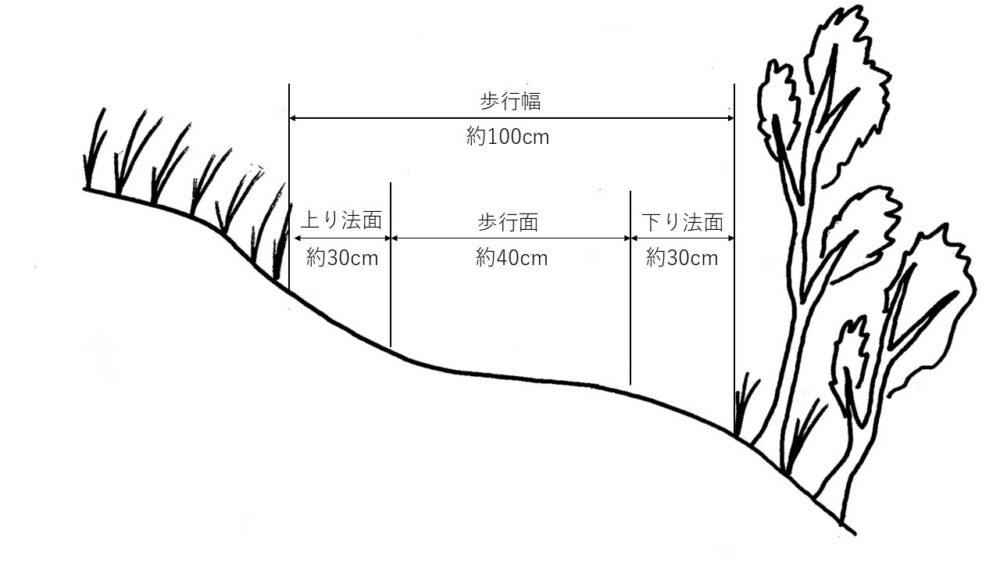
Next up is trail maintenance.
We will proceed with the site preparation using the following steps.
- Remove fallen leaves from the walkway
- Remove rocks and branches from the path
- Grade the uphill slope to 45° or less
- Grade the walking surface so that it slopes slightly toward the valley (to allow water flowing onto the trail to drain gently and prevent erosion).
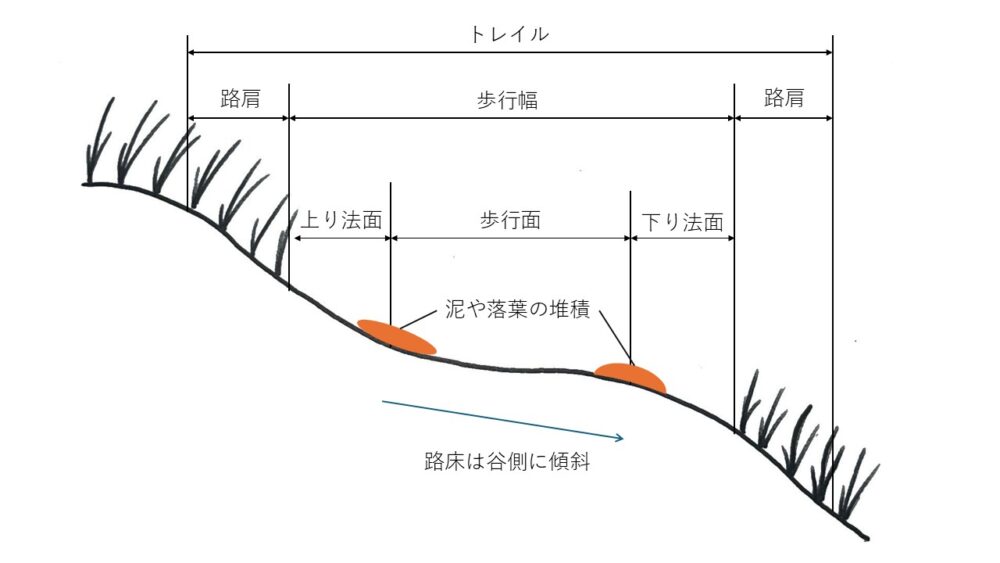
By keeping the trail to a minimum size and ensuring an easy-to-walk surface, hikers are encouraged to stay on the trail.
The idea is to concentrate the impact on the trail itself in order to protect the surrounding natural environment.
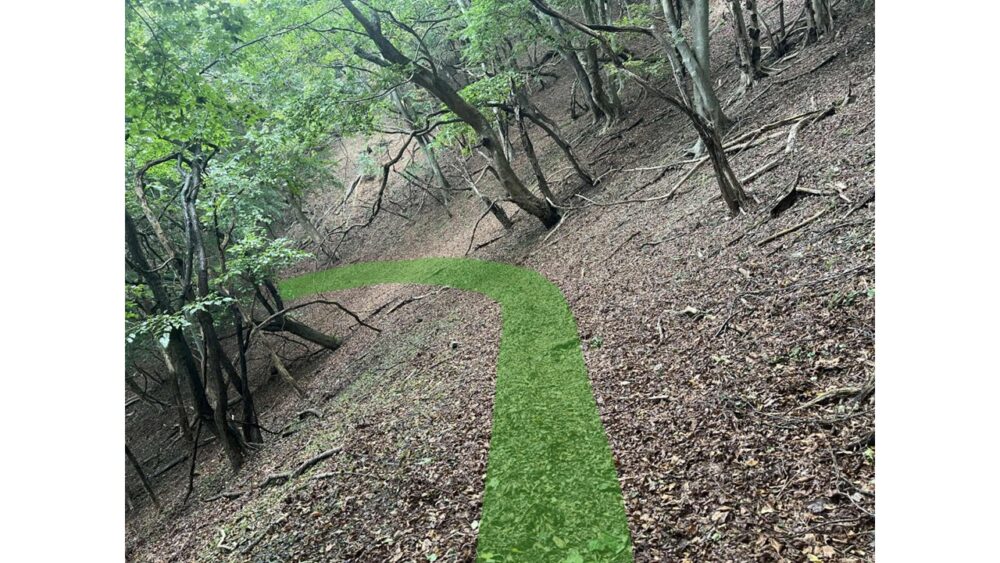
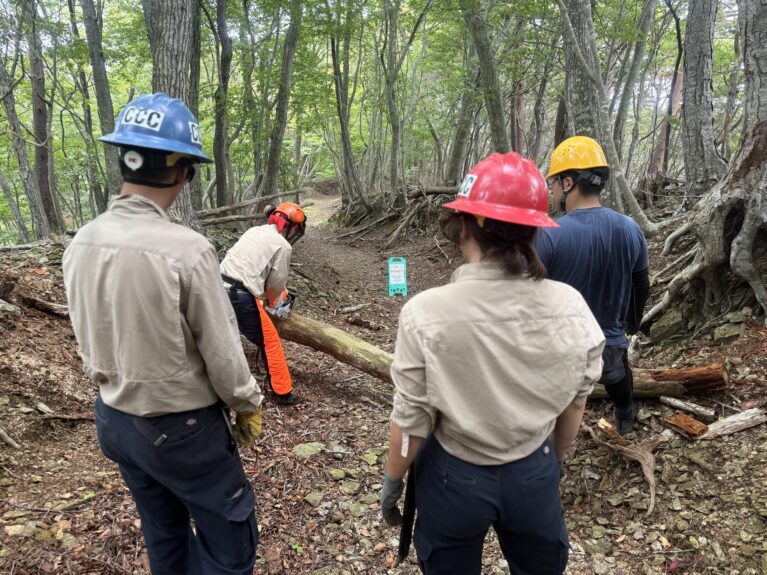
In addition to land grading, we also planned to remove fallen trees and snags that were deemed to pose a safety hazard to hikers.
Maintenance Work and Subsequent Developments
Maintenance work was carried out over two days: Sunday, September 28, 2025, and Wednesday, October 1, 2025.
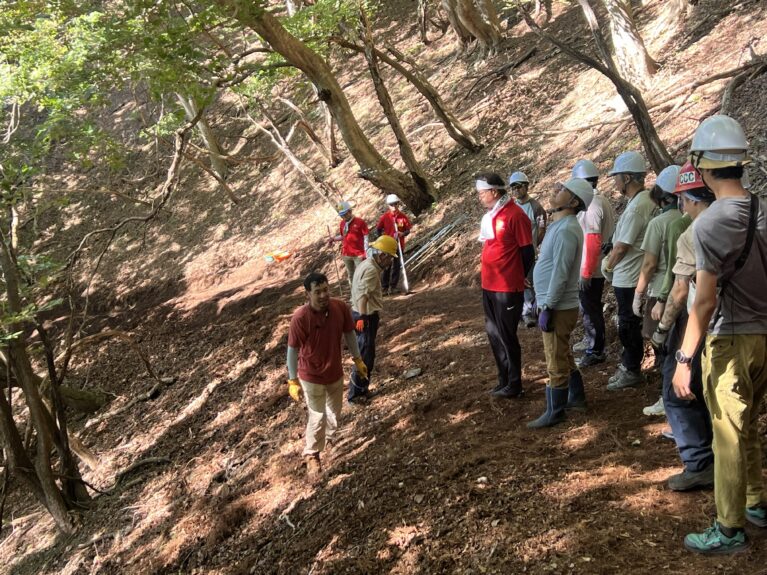
On Sunday, September 28, the maintenance was conducted as part of an event titled “Trail Maintenance Meeting 2025” in Ofunato. Thanks to the cooperation of hikers, local residents, and representatives from numerous companies, municipalities, and government agencies, we were able to make significant progress on the maintenance all at once.
A brief safety briefing and explanation of the tools are provided before departure.
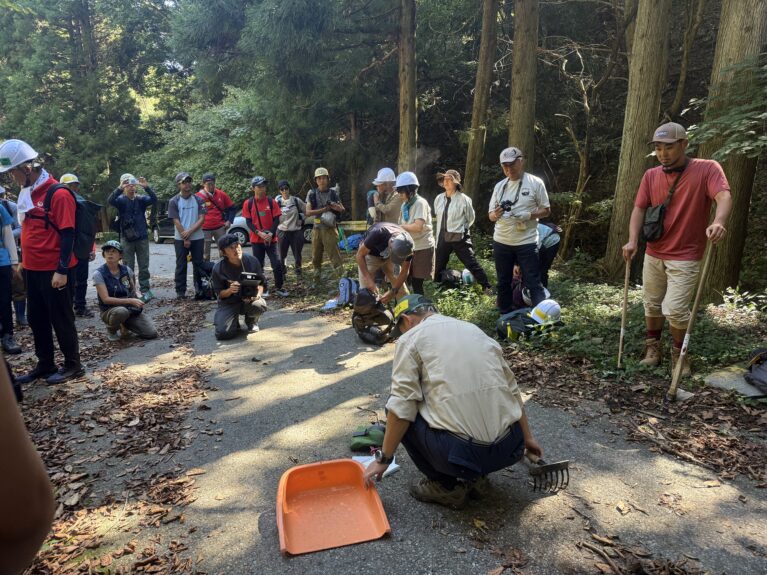
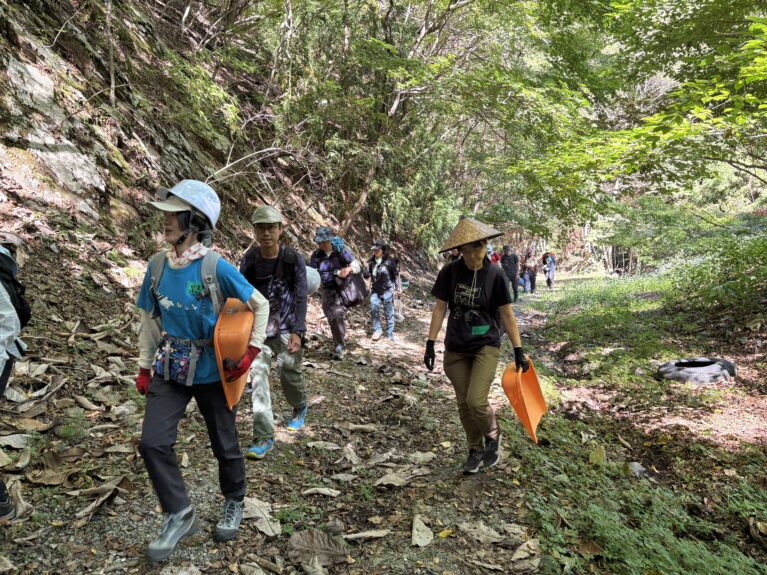
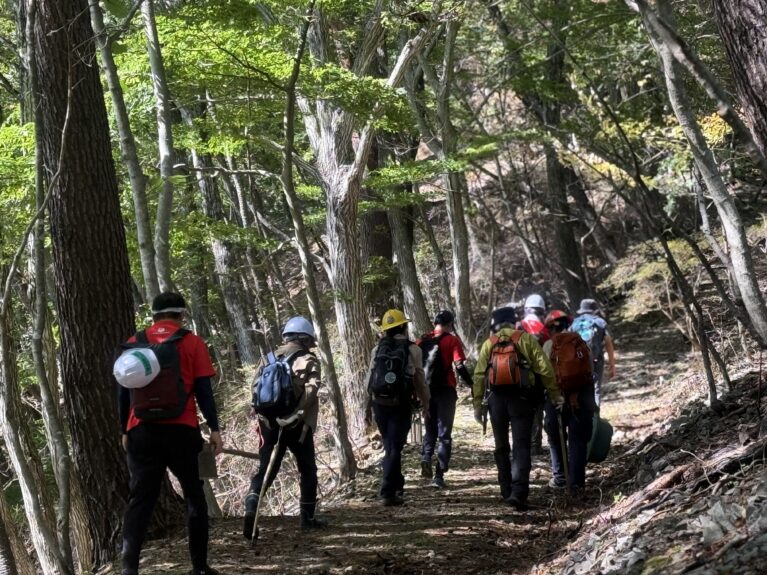
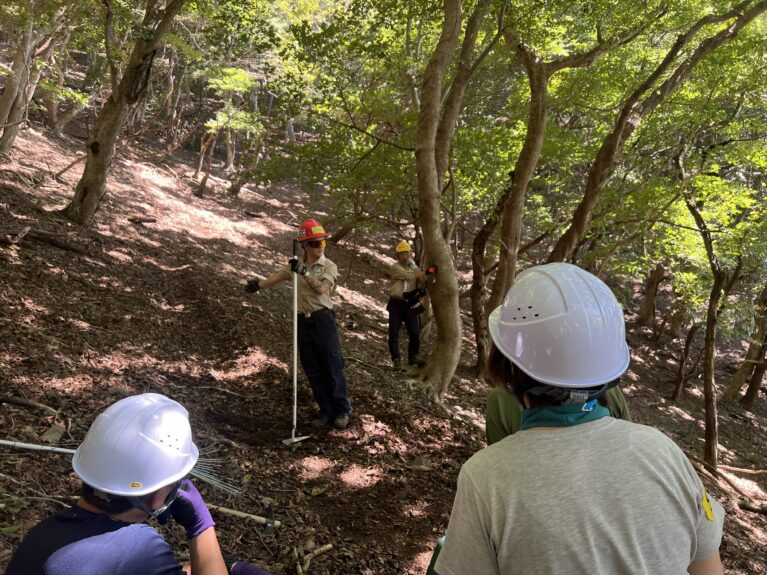
First, CCC members will give a demonstration of site preparation, and then we will begin the work.
- I cleared the fallen leaves from the walkway.
- I removed the rocks and branches that were in the way of walking.
- The uphill slope was cut to an angle of 45 degrees or less.
- The walking surface was graded so that it slopes slightly toward the valley (to gently channel water flowing onto the trail and prevent erosion).
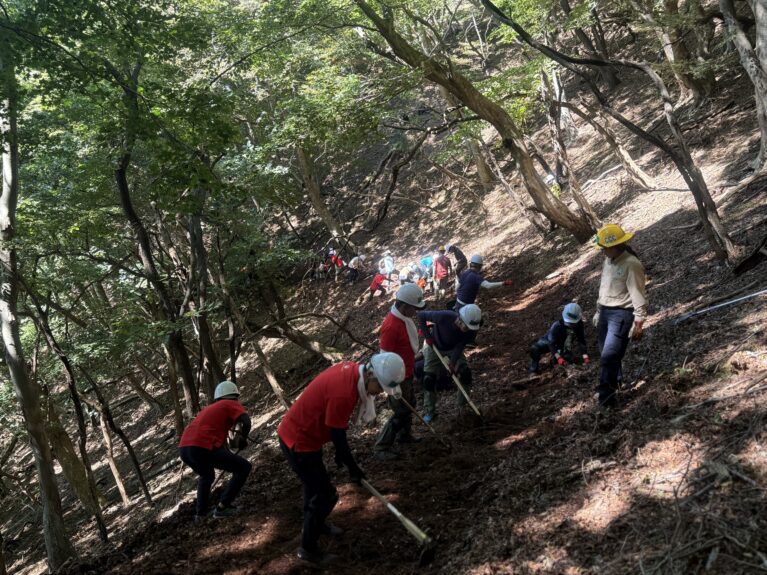
We graded the trail while making sure to leave ample room for hikers to walk, so the trail is now quite distinct.
(The walking width might have been a little narrower.)
This should help concentrate the impact on the trail and ensure hikers’ safety.
September 25, 2025
September 28, 2025
We also took measures to address fallen trees and snagged trees that posed a safety hazard.
Summary
We previously introduced “Collaborative Trail Maintenance with CCC: Ofunato City—Ayazato Pass, Part 4.”
This time, at Ayazato Pass—which was damaged by a forest fire—we cleared the trail, which had been buried under fallen leaves and debris.Many people who love this trail—including local residents, hikers, government officials, and corporate representatives—joined us in this effort. The warm sentiments of everyone hoping for recovery from the forest fire took shape, and the trail has been reborn as an even better trail.
We plan to continue conducting regular patrols and work together with everyone to keep protecting this trail.
Article by: Ryota Matsukawa