

Report on the Maintenance Implementation Workshop in Ogatsu-cho, Ishinomaki City
In this article, we’ll provide a detailed report on the “On-Site Maintenance Training Session” held in Ogatsu-cho, Ishinomaki City.
The purpose of this “Field Maintenance Training Workshop” is to train volunteers who can learn and implement “environmentally friendly” maintenance methods that minimize the impact on nature, thereby helping to maintain trails where hikers can walk safely.
Overview
Date and Time: Monday, April 21, 2025, and Tuesday, April 22(Tue)
Location: Ogatsu-cho, Ishinomaki City—Funakoshi Peninsula
Organizer: Certified NPO Michinoku Trail Club
Target Audience: Trail Maintenance Leaders
Other Participants: Hikers, local residents, members of the Ishinomaki Mountain Club, the Tourism Policy Division of Ishinomaki City’s Department of Industry, and representatives from the Ministry of the Environment’s Ishinomaki Regional Office
Details:
April 21 (Mon): Morning – Trail Survey and Planning / Afternoon – Trail Maintenance
April 22 (Tue): Trail Maintenance
Background
This time, we conducted trail maintenance in the Ogatsu-machi area of Ishinomaki City along the Michinoku Coastal Trail.
This section harmoniously blends the dynamic coastal beauty of Sanriku Revival National Park with the tranquil scenery of a fishing village.On the Funakoshi Peninsula, which juts out into the Pacific Ocean, you can enjoy scenery typical of the Sanriku region, featuring a succession of rugged cliffs and bizarre rock formations carved by the waves.The iconic Osuzaki Lighthouse, located near the trail, offers a captivating panoramic view of the vast Pacific Ocean. You can also experience the beautiful townscape and crafts made from the local specialty, “Ogatsu Stone” (natural slate), and feel the community’s resilient progress since the earthquake.
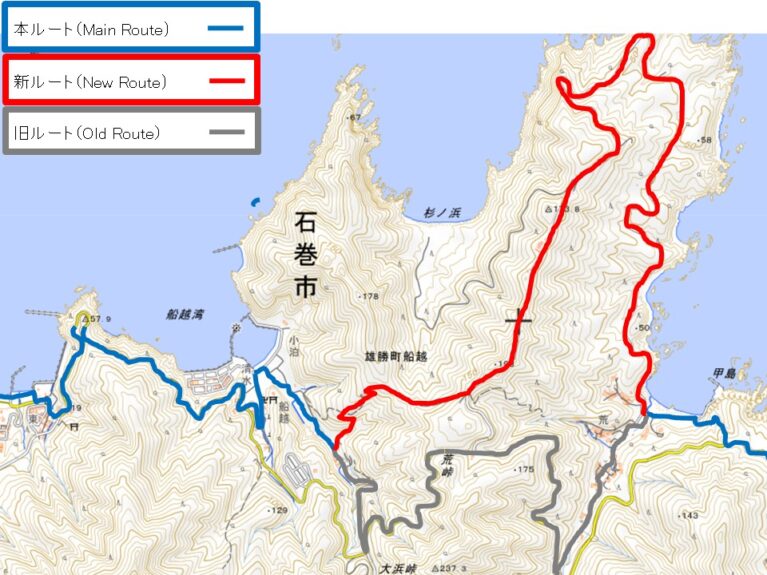
Originally, the trails in this area were the gray routes shown in the figure below.
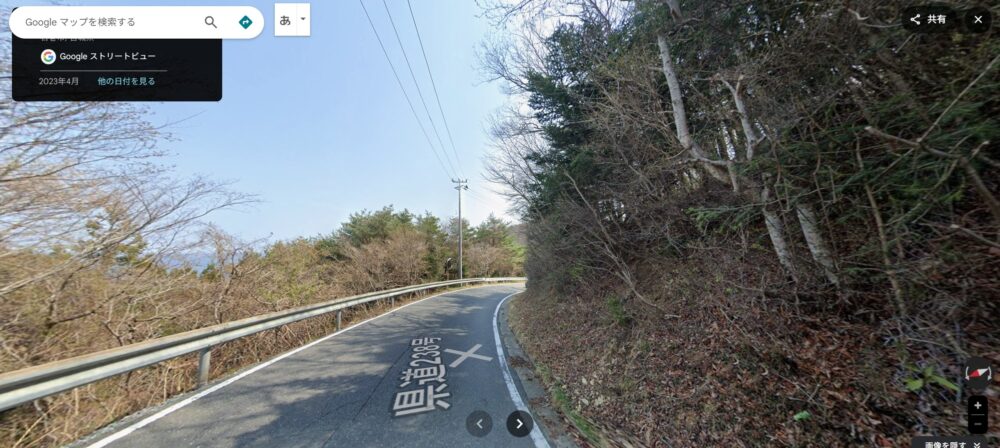
Prefectural Route 238, which passes through the old route at Ara Pass, had many curves and poor visibility, and with heavy traffic, it was hardly an ideal trail for hikers.
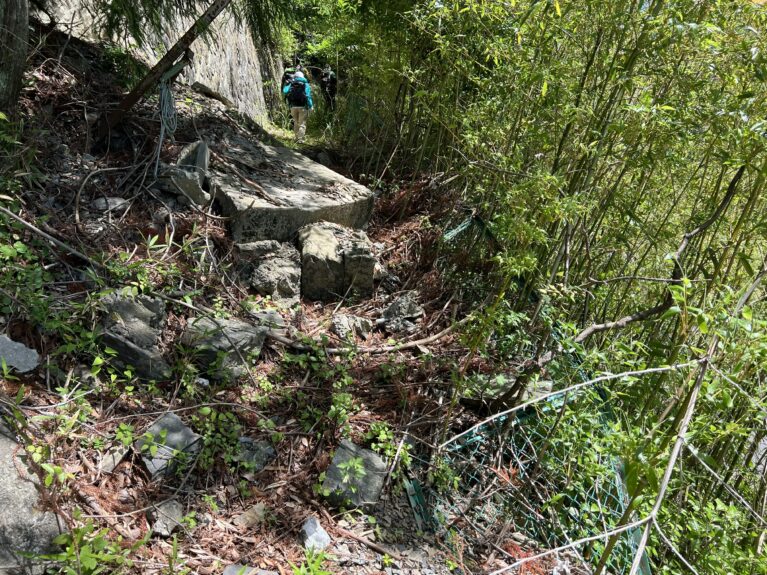
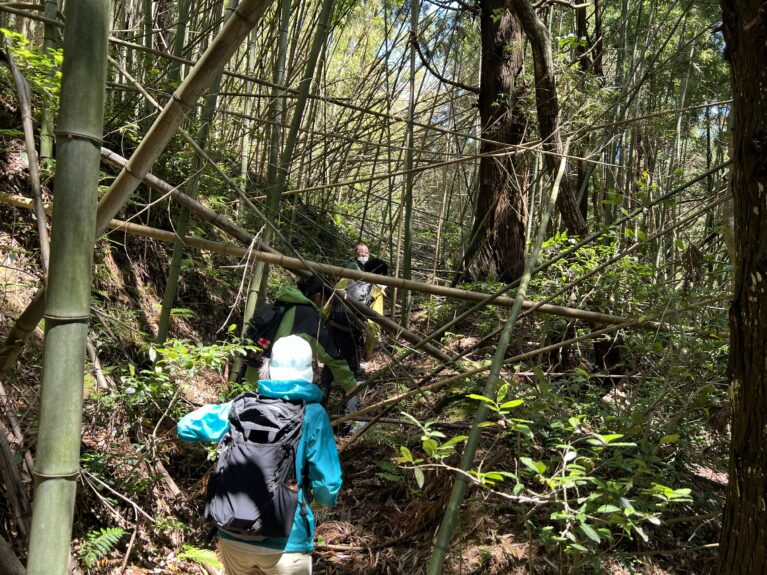
Consequently, in order to ensure hikers’ safety and enhance the quality of the hiking experience, plans to reroute the trail were considered. However, this process proved quite difficult. When we followed the dotted lines on the map, we found that the asphalt and fences had crumbled, and bamboo thickets blocked our path.
Just as I was beginning to feel that opening this new path would require a considerable amount of effort, a local resident told me, “There’s another path.” It turned out to be a nature trail that runs behind the former Funakoshi Junior High School, and I was told that children used to walk to school along that path back in the day. I went to check it out right away and found that, with a little work, it looked like it would be passable.Furthermore, we decided on this route because passing through the site of the former junior high school would also be a good way to learn about the area’s history.
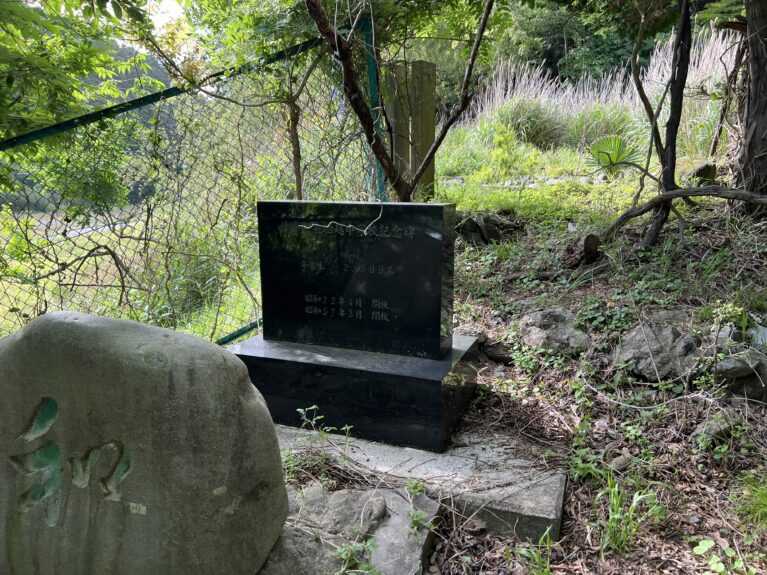
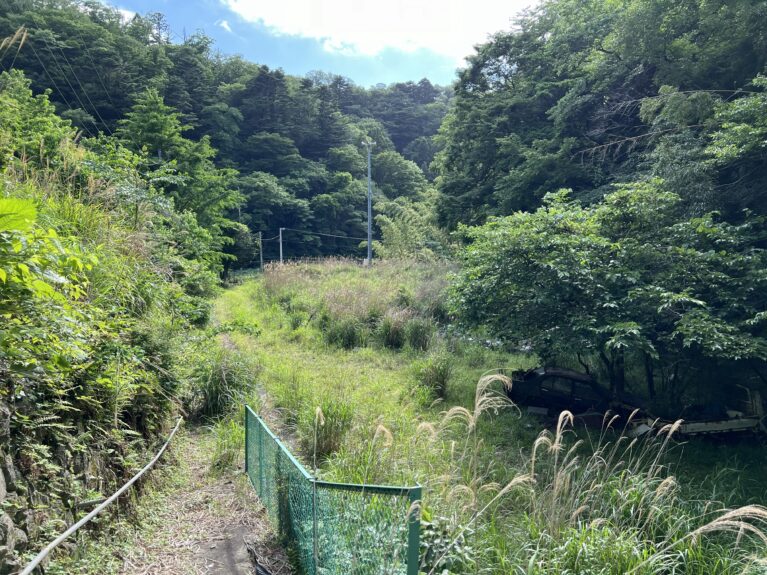
The final route enters the nature trail that runs behind the former Funakoshi Junior High School and then circles the entire Funakoshi area before emerging at Arahama Beach (the red route in Figure 1).
Trail Survey and Review
On the first day of the hands-on trail maintenance training session, we all conducted a survey and discussion before beginning trail maintenance.
Although it had been used in the past, there were no signs of use for many years; it was overgrown, and there were countless fallen trees.
When I proposed that fallen trees on the trail should, in principle, be removed, someone asked, “Do we really need to remove them all? Wouldn’t it be more natural to leave the ones we can step over as they are?”
This is a very important discussion, and there isn’t necessarily a single “correct” answer.
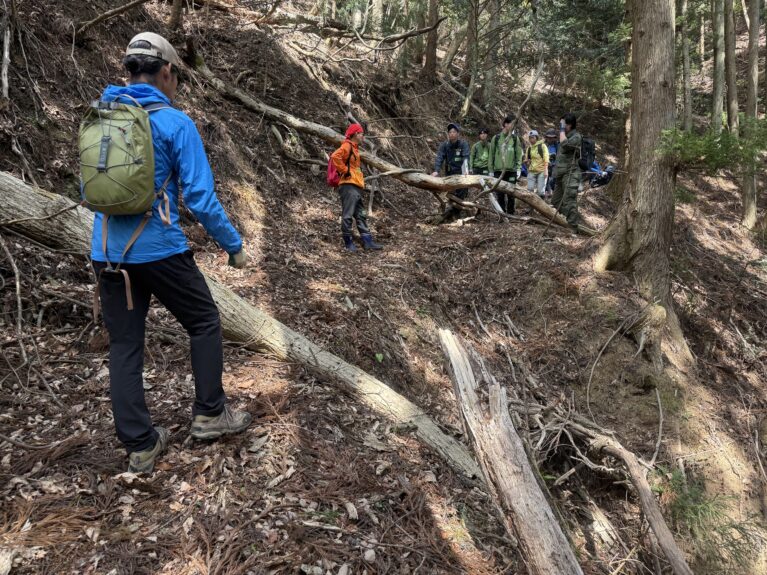
When considering trail maintenance, I try to focus on the following three points.
- Are the ecosystems along the trail and in the surrounding area being preserved?
- Are conditions being maintained so that hikers can walk safely?
- Is the primal experience of hiking still preserved?
1. Are the ecosystems along the trail and in the surrounding area being preserved?
↓
If it is difficult to step over a fallen tree, hikers may be tempted to walk off the trail to avoid it.
2. Are conditions maintained so that hikers can walk safely?
↓
If you step over a fallen tree, you risk tripping and falling. Also, if you crawl under a fallen tree, there is a risk—in the worst-case scenario—that the tree could crush you from above. Furthermore, in areas where fallen trees are frequent, you’ll end up expending more energy and time.
3. Is the primal hiking experience being preserved?
↓
We need to create an environment where hikers can focus on their experience of nature, while taking care not to disrupt the natural scenery and sounds of the wilderness.In fact, while it is physically possible to walk around fallen trees without removing them, the quality of the hiking experience deteriorates when fallen trees appear repeatedly over short stretches.
There is no single “correct” answer to this debate.
In some cases, I believe it may be acceptable to leave some fallen trees in place.
(For example, if there are animals raising their young in a nest within a fallen tree, and it is determined that there is no risk to hiker safety.)
In any case, we have no choice but to make decisions while considering what kind of hiking experience we want to provide, all while protecting the natural environment and ensuring hiker safety.
Following the discussions outlined above, we have decided, as a general rule, to remove fallen trees.
Trail Challenges and Maintenance Plans
The challenges on the trail can be summarized as follows:
- There are a large number of fallen trees on the trail.
- Fallen leaves and soil have accumulated on the trail.
- The trail surface is unpaved
- There is a ditch (water channel) on the trail.
- The trail is unclear.
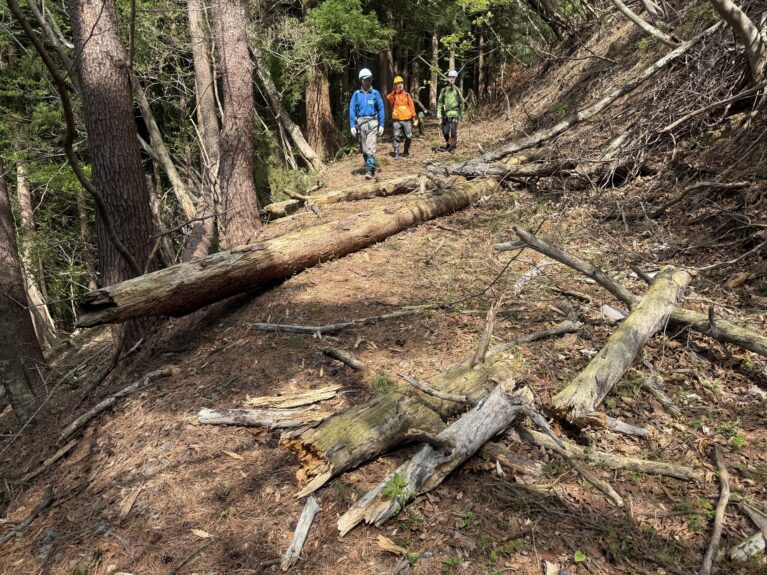
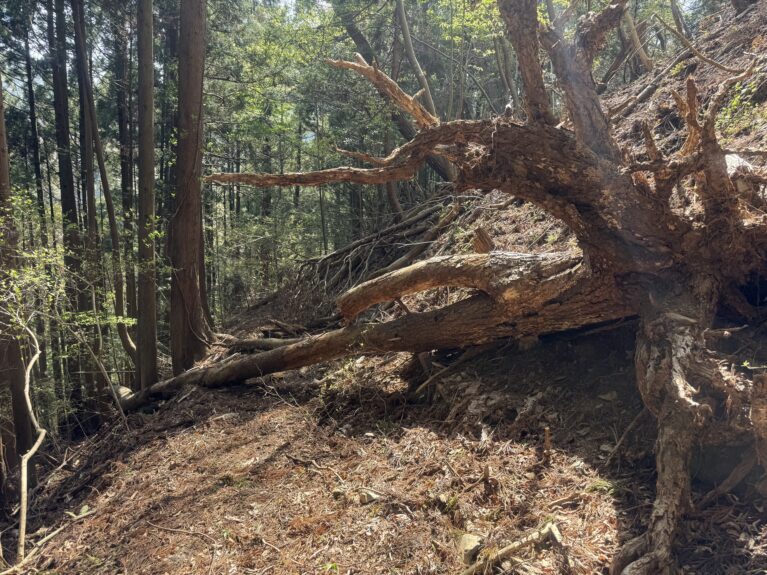
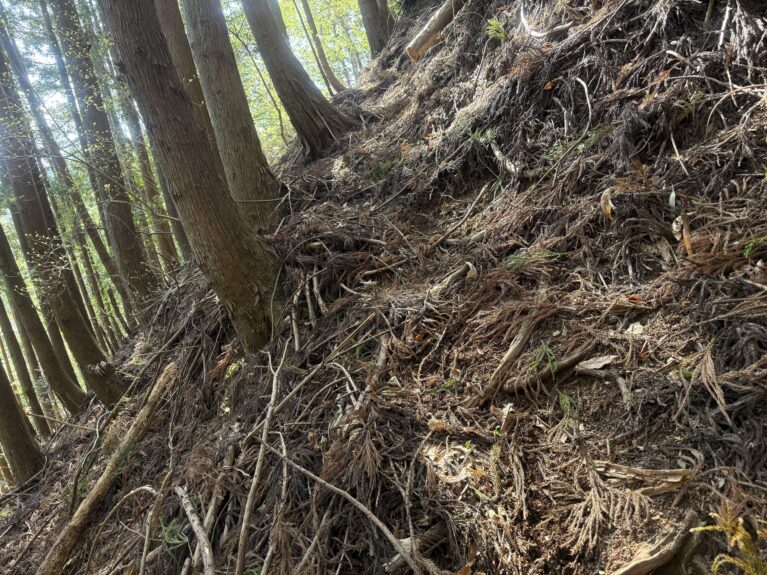
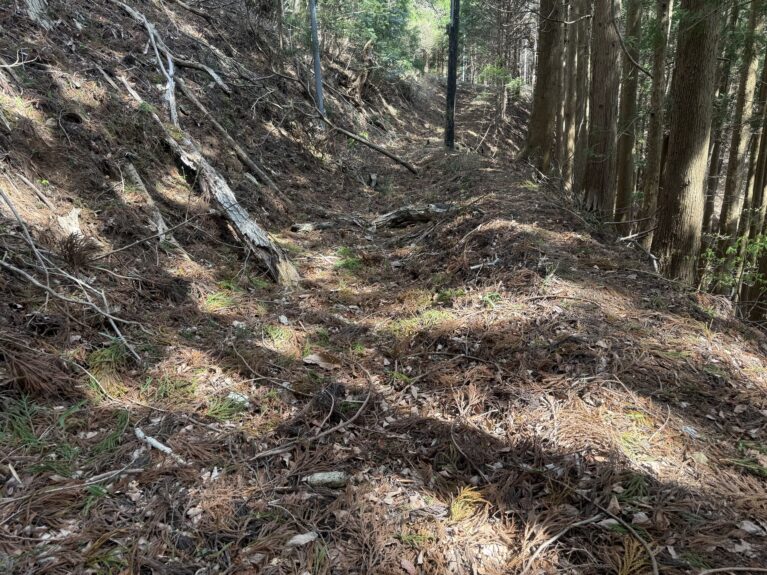
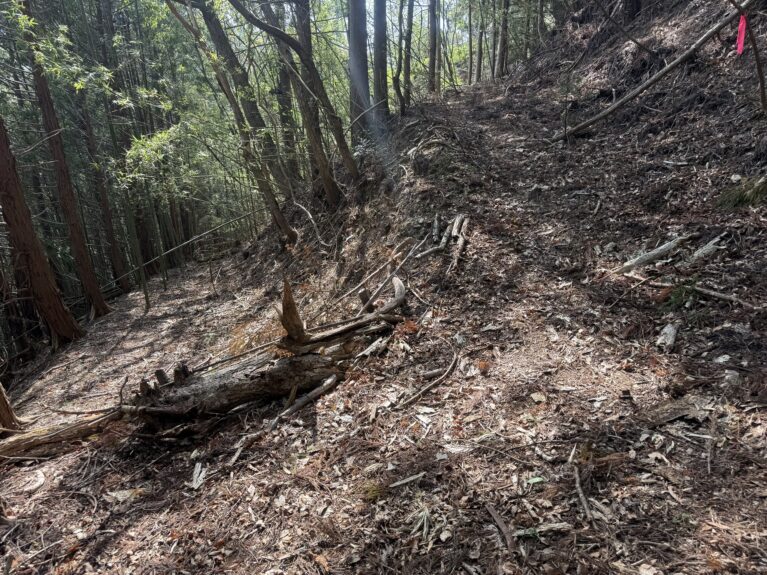
For trail maintenance, we decided to split into three teams and work in order from Team 1 to Team 3.
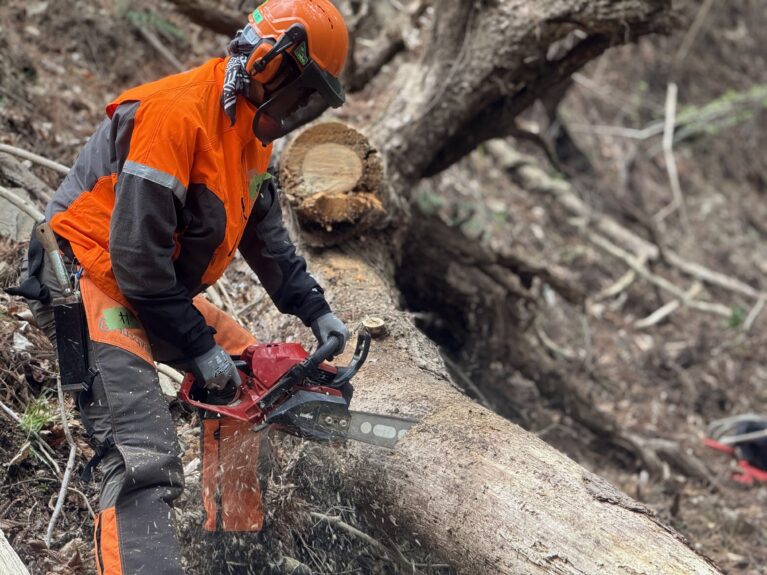
Team 1: Fallen Tree Removal Team
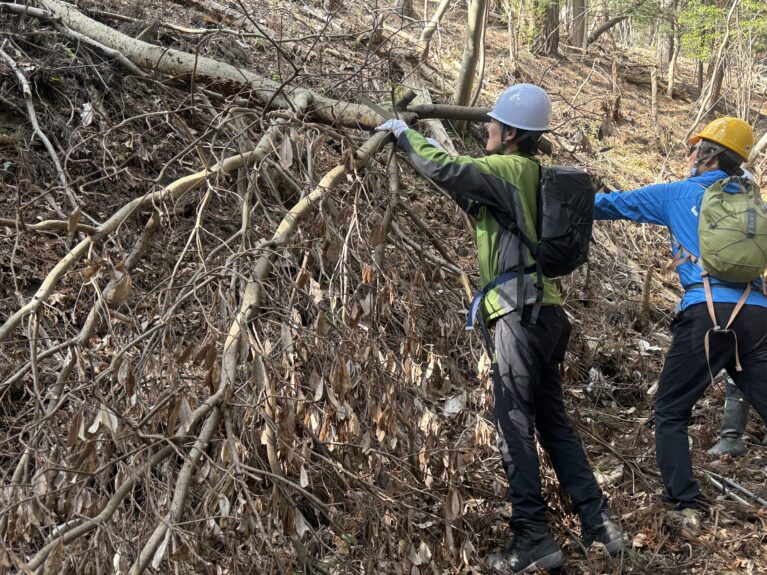
Team 2: Pruning and Weeding Team
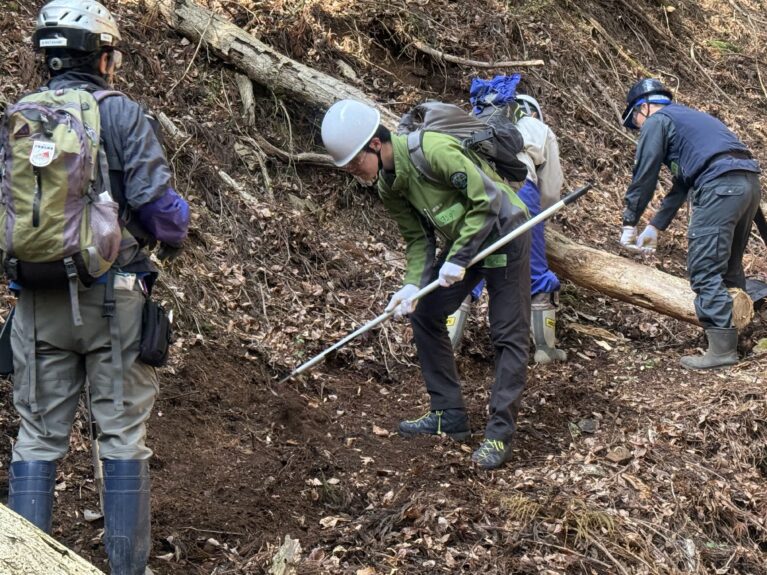
Team 3: Grading Team
Team 1: Fallen Tree Removal Team
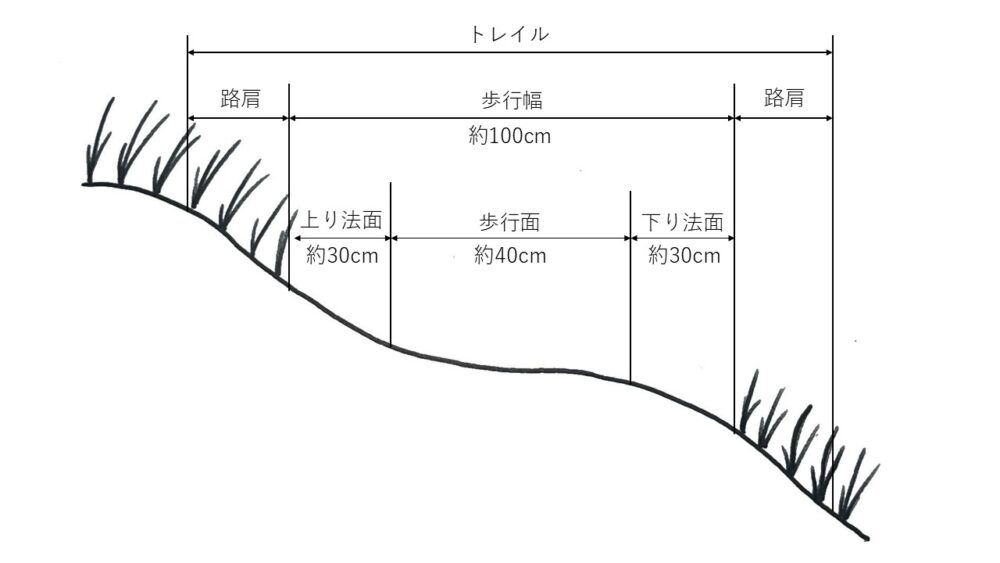
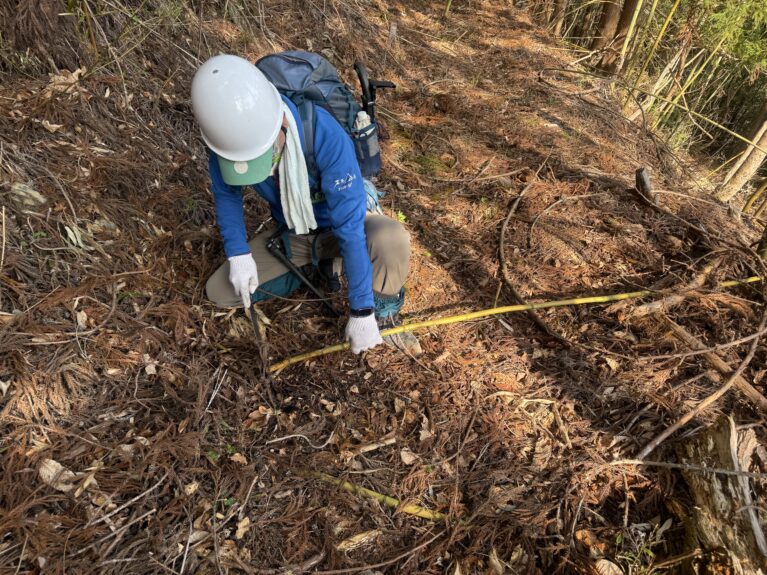
When constructing a new path, we typically set the walking width to about 100 cm, but in this case, we decided to make use of the existing path (although the actual walking width is about 2 to 3 meters, we did not force it to be narrower and instead utilized the original width).
First, we’ll remove the fallen trees that are blocking the walkway.
Group 2: Pruning and Weeding Team
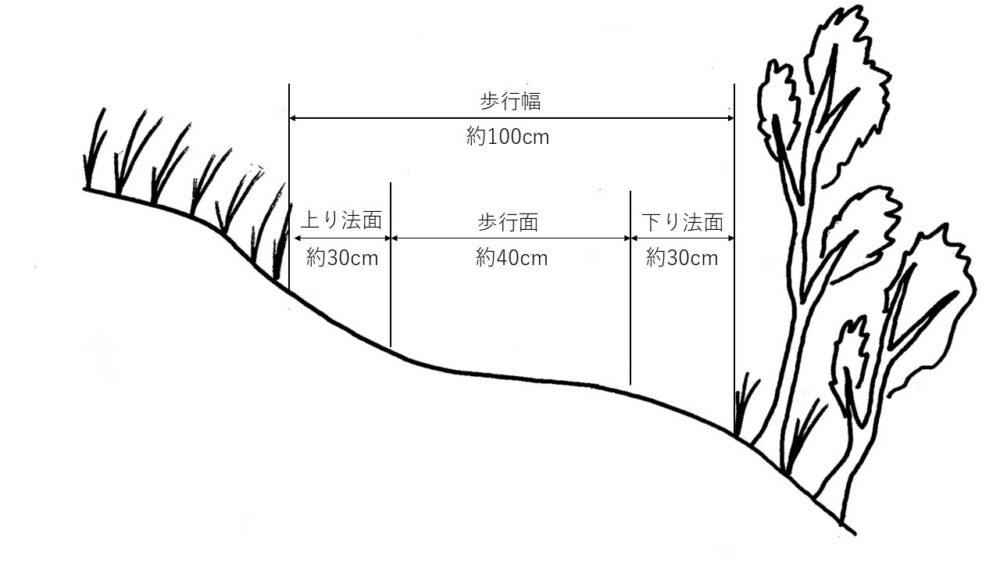
Next, we’ll trim the branches within walking distance and mow the grass.
Although the height is not specified in this diagram, we are using approximately 2 meters as a guideline.
In any case, we ensure that branches and grass do not brush against the bodies of hikers carrying large backpacks, and we maintain the minimum amount of space necessary for them to pass each other.
In addition, since hikers tend to veer toward the valley side, we design the trail so that the vegetation on the valley side is allowed to grow tall, thereby encouraging hikers to stay on the trail.
Group 3: Site Preparation Team
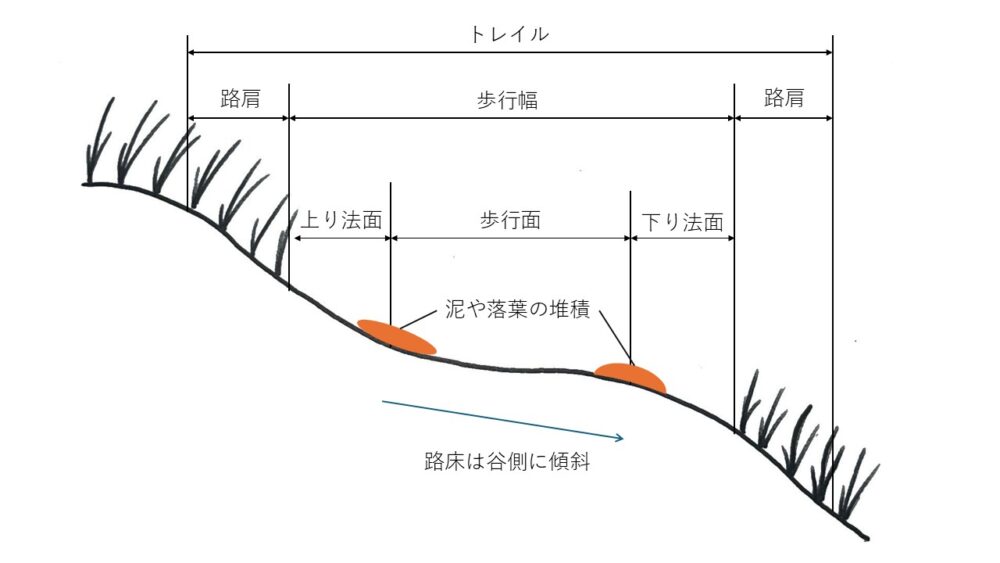
Remove fallen branches, leaves, and mud that have accumulated on the trail.
Since these tend to accumulate especially along the edges of the walking surface, focus on removing them from those areas.
Generally, tree roots are left in place, but thin roots protruding onto the walking surface that obstruct passage are removed.
If necessary, the uphill slope is cut to an angle of 45° or less, and the walking surface is sloped slightly toward the valley side. This allows water flowing onto the trail to drain quickly and protects the trail bed from erosion caused by water.
We will also fill in any ruts (water channels) that have formed on the trail and install signs in areas where the path is difficult to follow.
Maintenance Work and Subsequent Developments
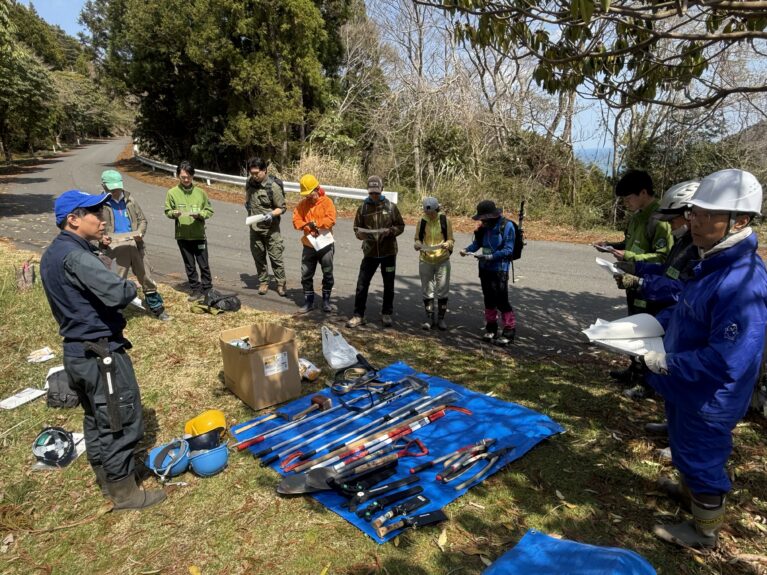
Before any maintenance work begins, we always conduct a safety briefing and provide an explanation of the tools.
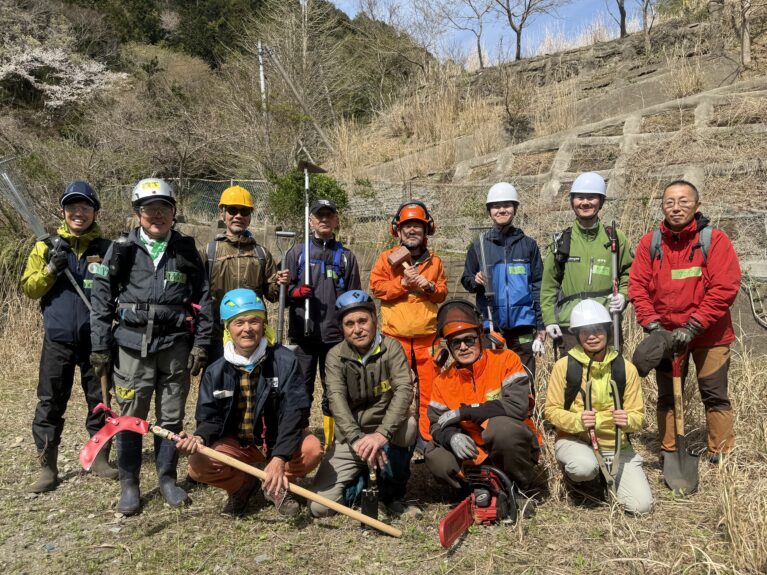
In this on-site maintenance training session, maintenance leaders are learning not only maintenance knowledge and skills but also how to manage maintenance operations.
Since safety management is particularly important, we will take the time to handle it thoroughly.
After that, we split into three groups and worked in order from Group 1 to Group 3.
Group 1: Fallen Tree Removal Team
Group 2: Pruning and Weeding Team
Group 3: Land Grading Team
Maintenance Area 1
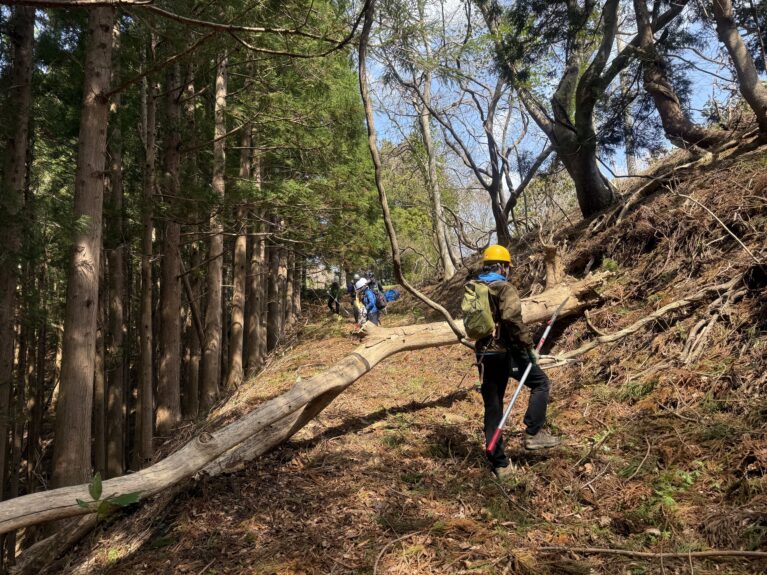
April 21, 2025
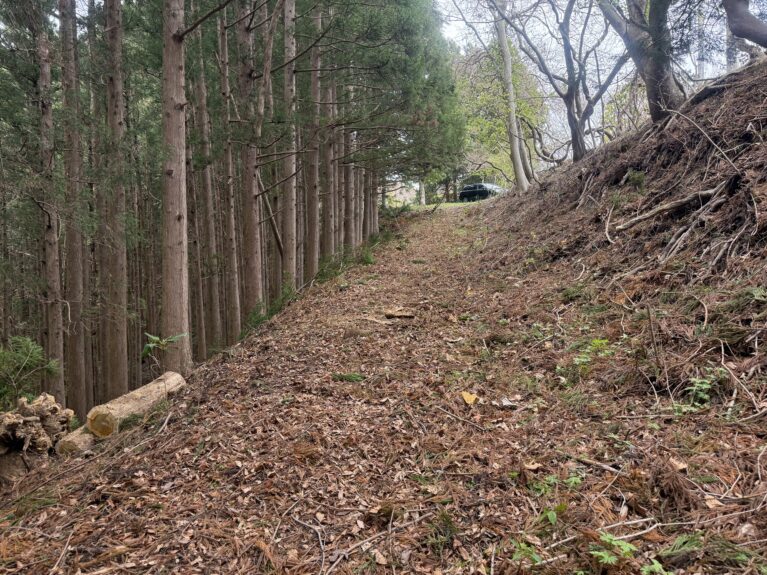
April 22, 2025
Maintenance Area 2
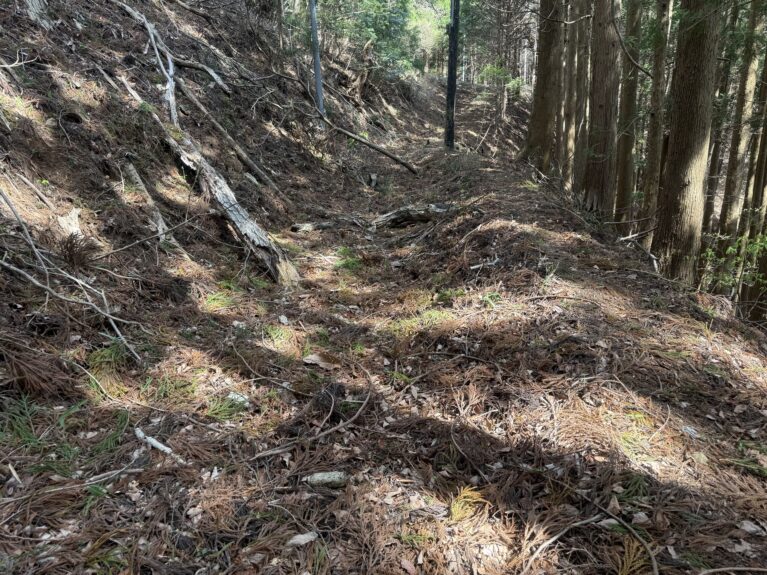
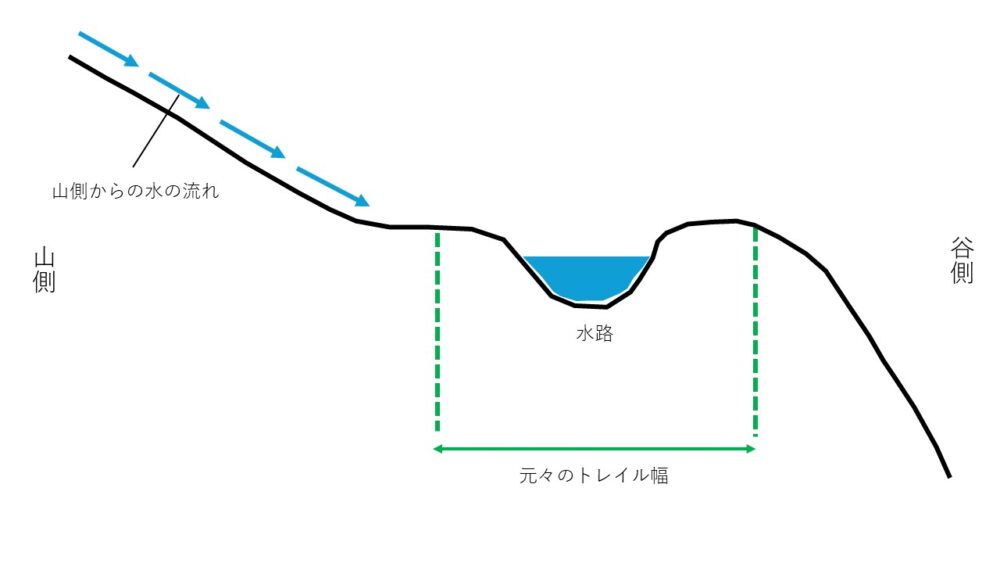
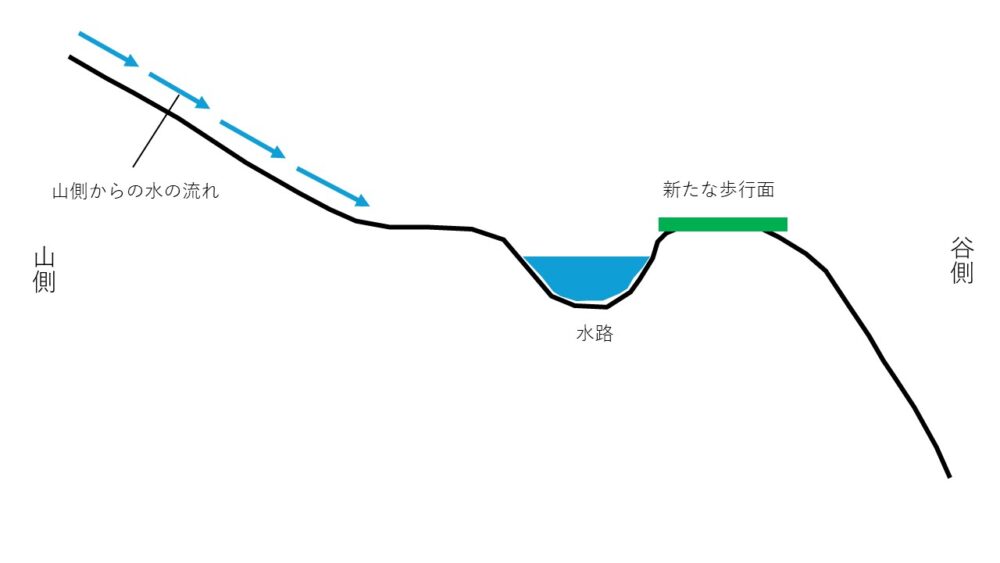
A ditch (waterway) has formed in the center of the trail.
Since this trail is naturally quite wide, we decided to separate the waterway from the walking path.
Since the mountainside is more susceptible to water flowing down from the slope, it is generally considered best to locate the walking path on the valley side of the waterway. Since a walking path had already begun to form on the valley side, we carefully graded that area. At the same time, we filled in the waterway with branches, fallen leaves, and rocks.
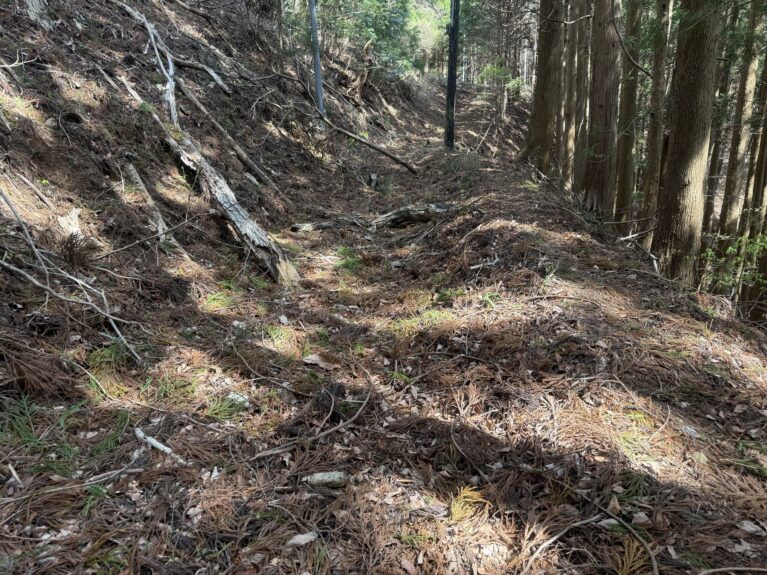
April 21, 2025
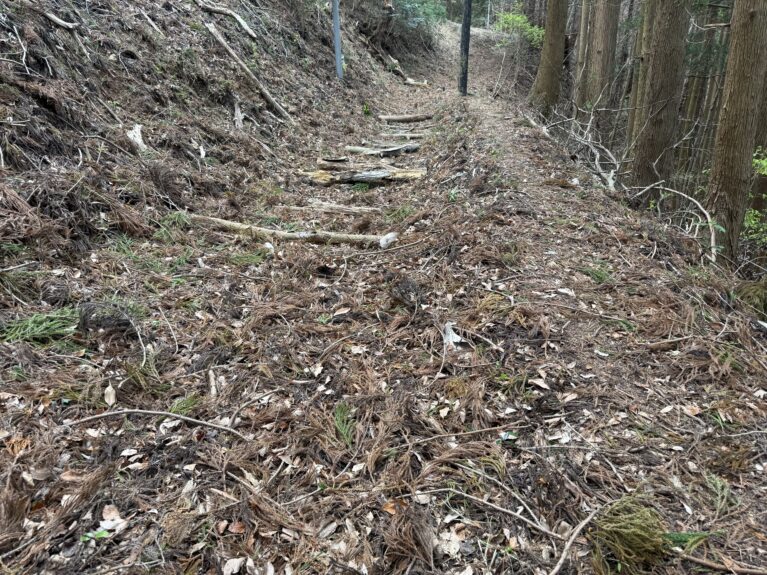
April 22, 2025
Maintenance Area 3
We cleared the fallen trees. Also, since the valley side had collapsed, we widened the mountain side slightly.
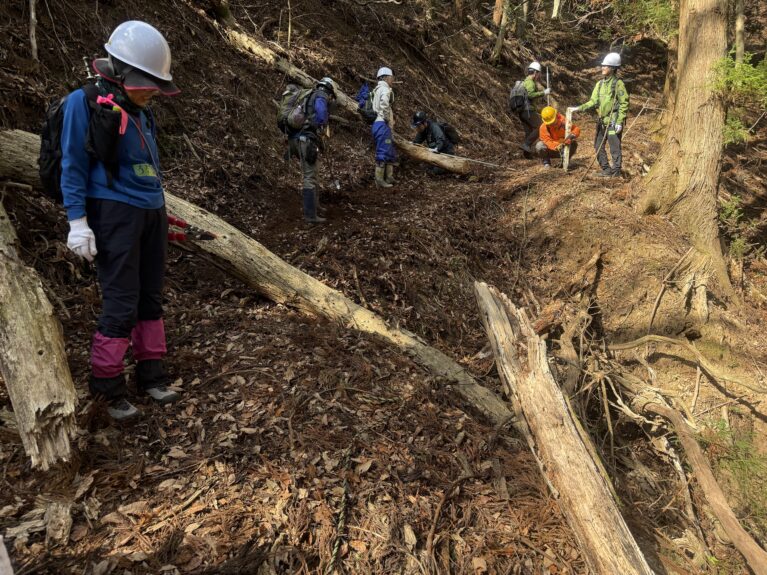
April 21, 2025
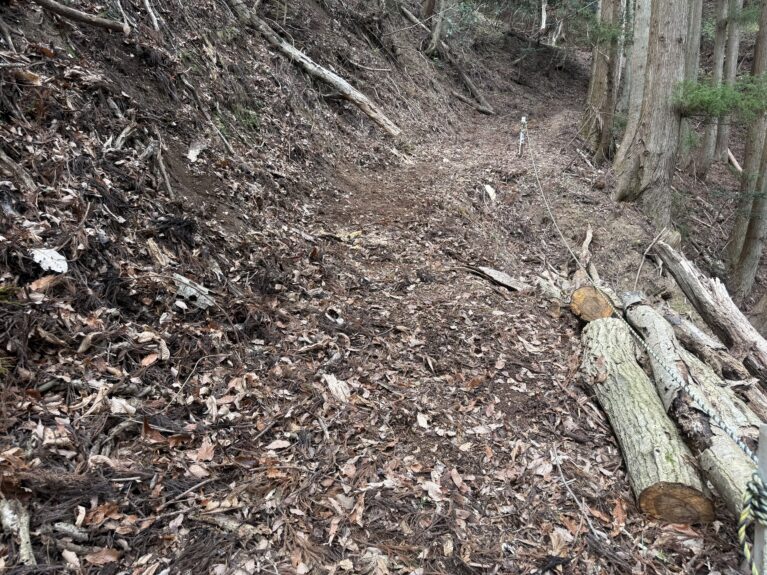
April 22, 2025
Maintenance Area 4
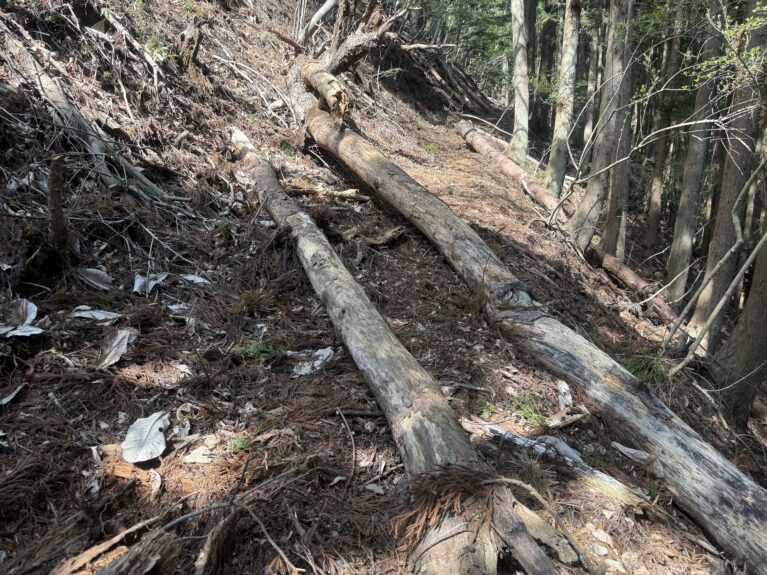
April 21, 2025
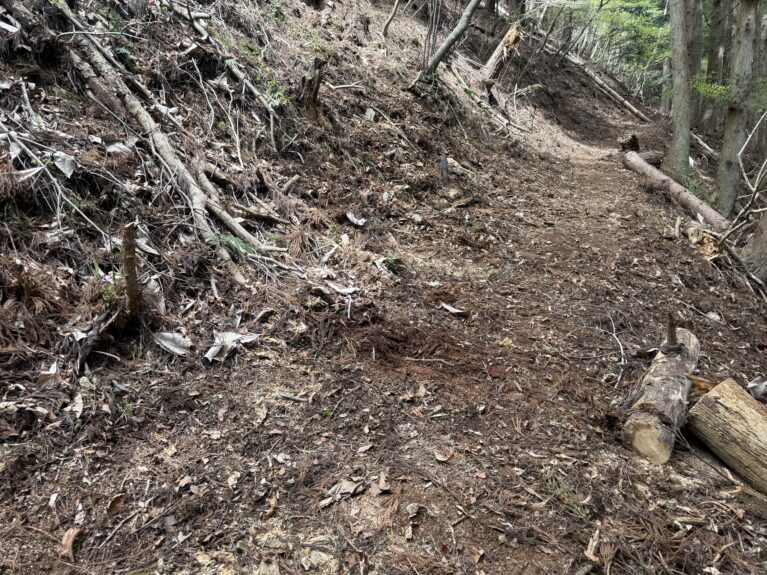
April 22, 2025
Maintenance Area 5
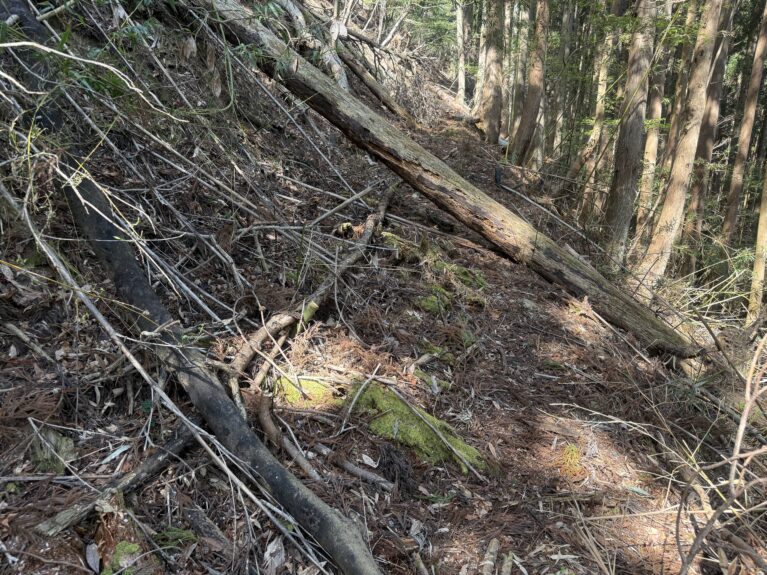
April 21, 2025
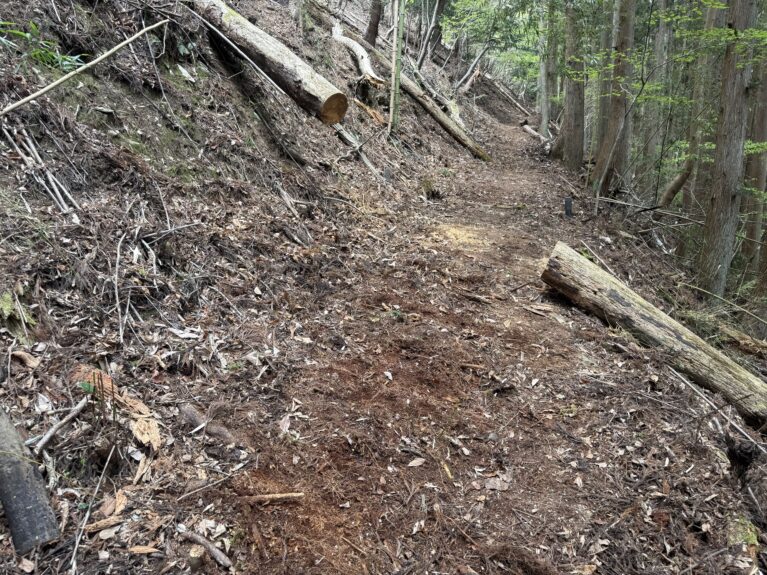
April 22, 2025
Maintenance Area 6
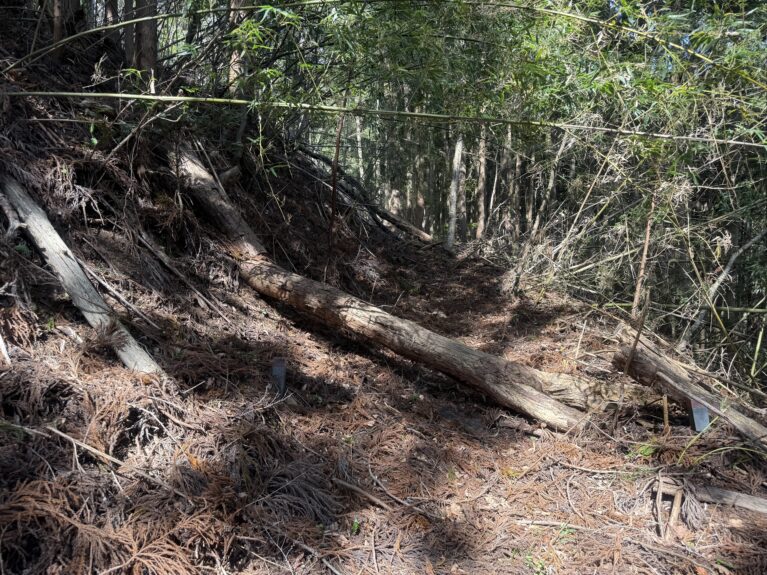
April 21, 2025
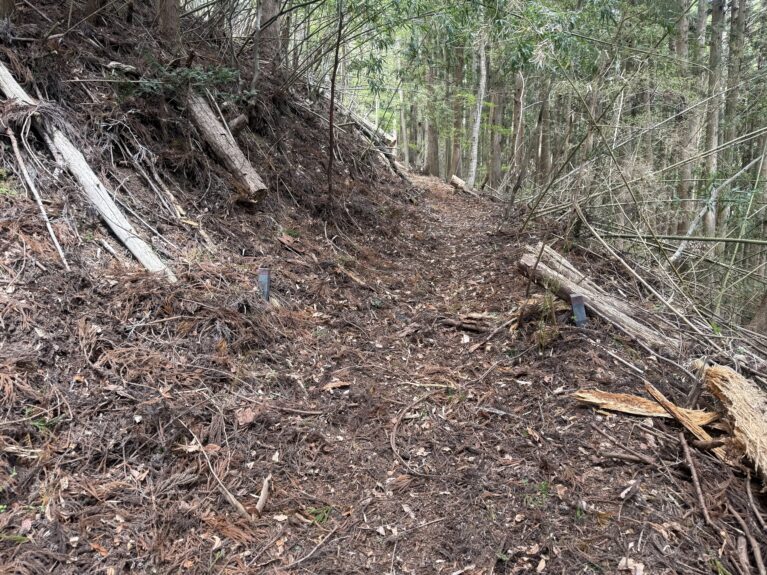
April 22, 2025
Maintenance Area 7
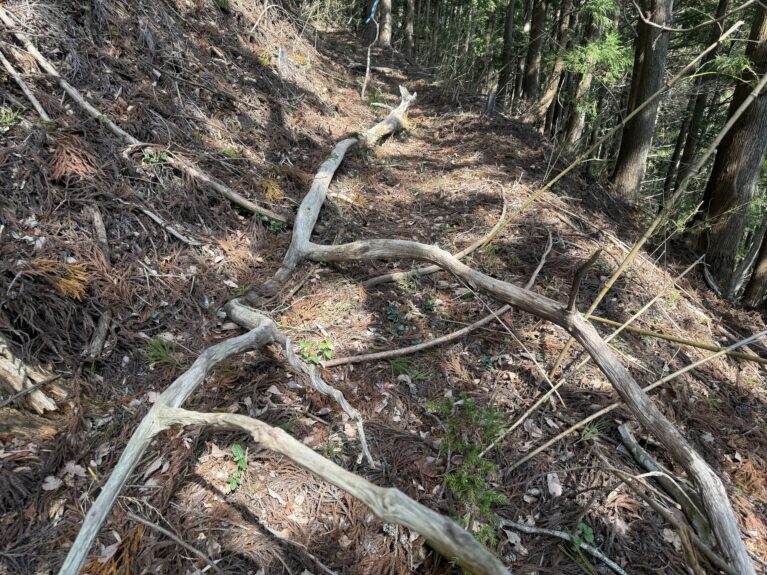
April 21, 2025
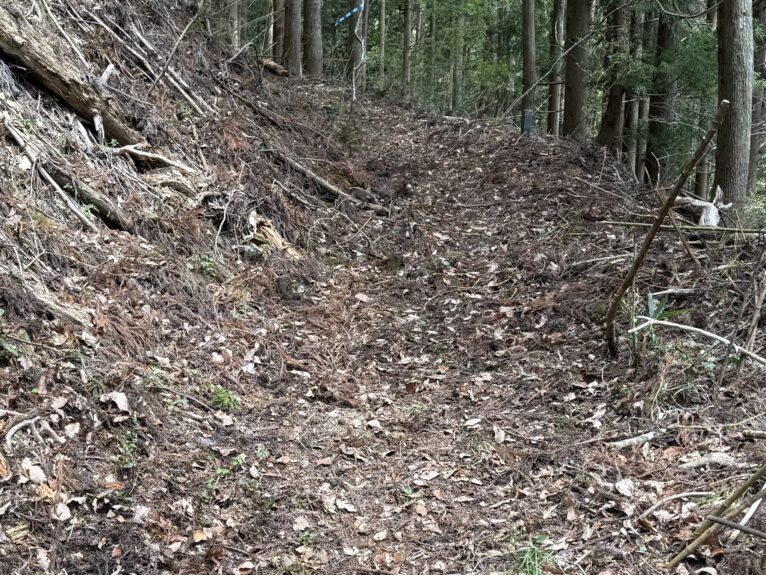
April 22, 2025
Maintenance Area 8
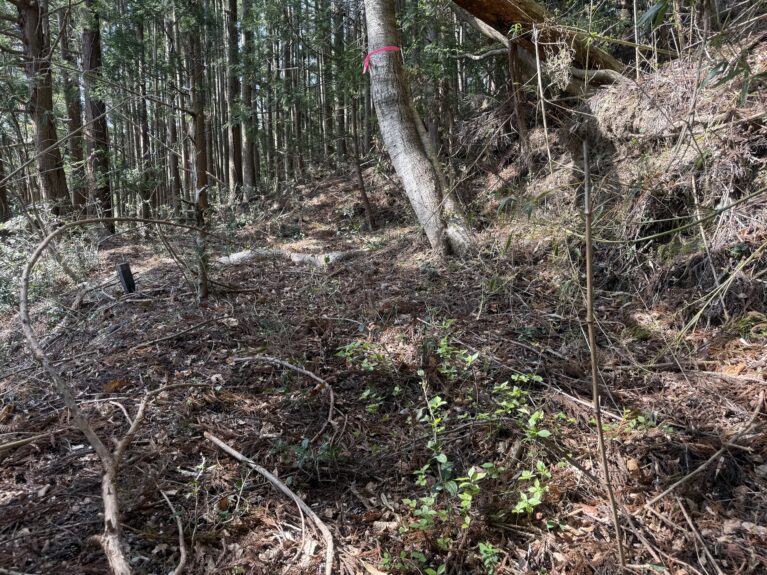
April 21, 2025
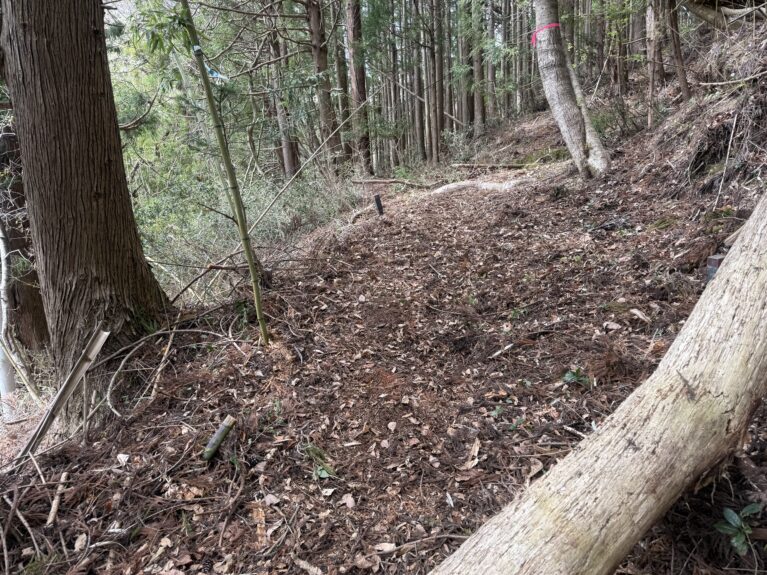
April 22, 2025
Maintenance Area 9
After clearing the fallen trees and leveling the ground, we posted signs to help people find their way.
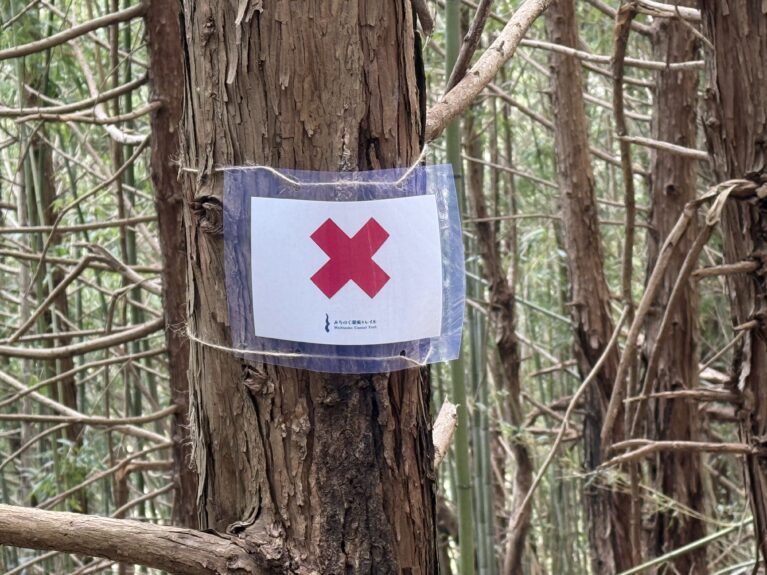
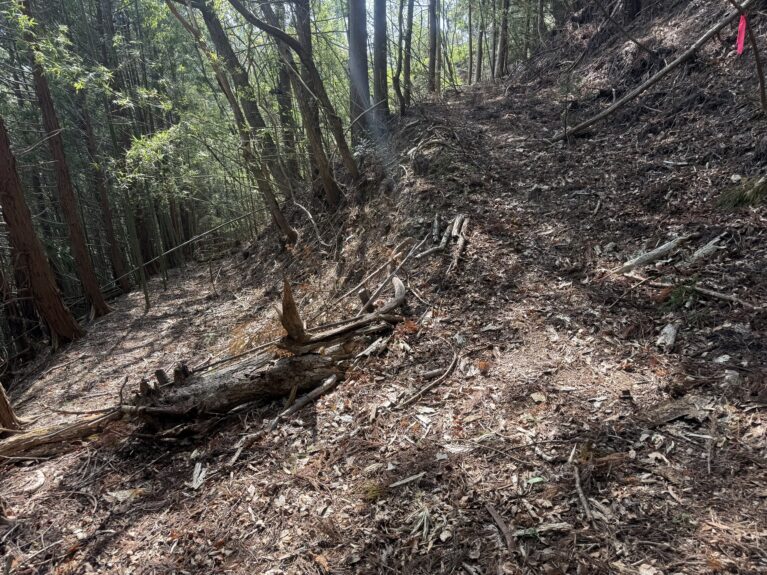
April 21, 2025
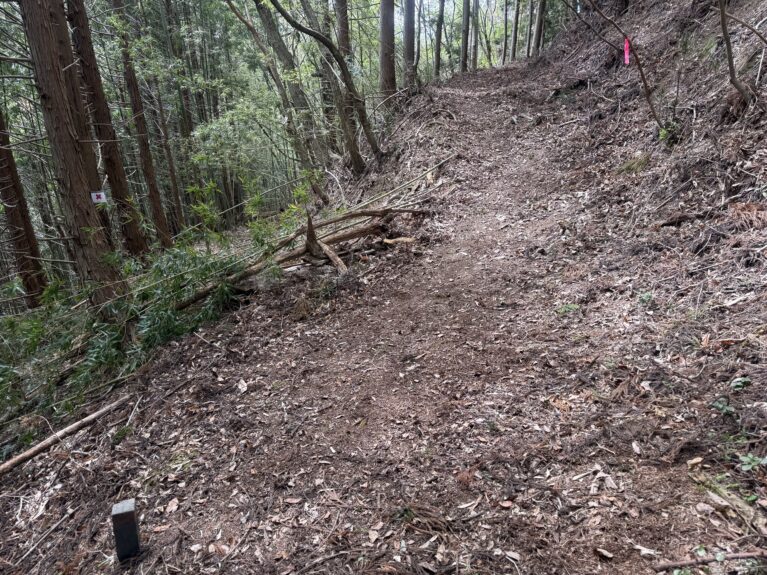
April 22, 2025
Maintenance Areas 10
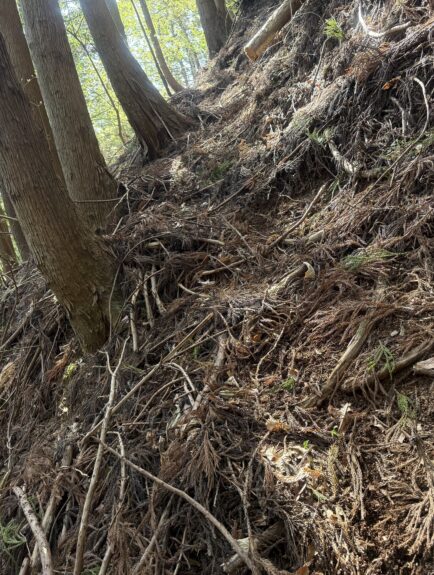
April 21, 2025
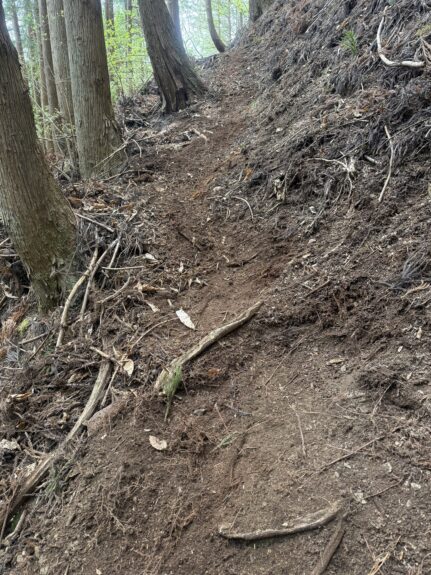
April 22, 2025
Maintenance Area 11
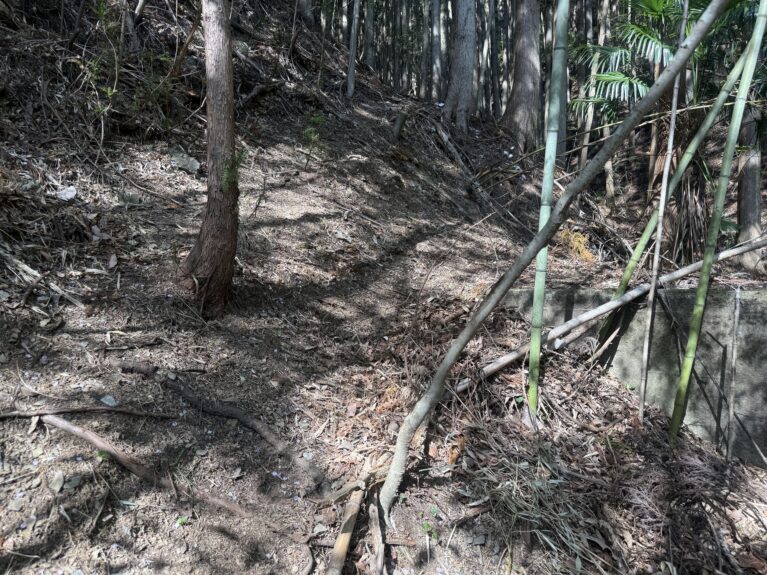
April 21, 2025
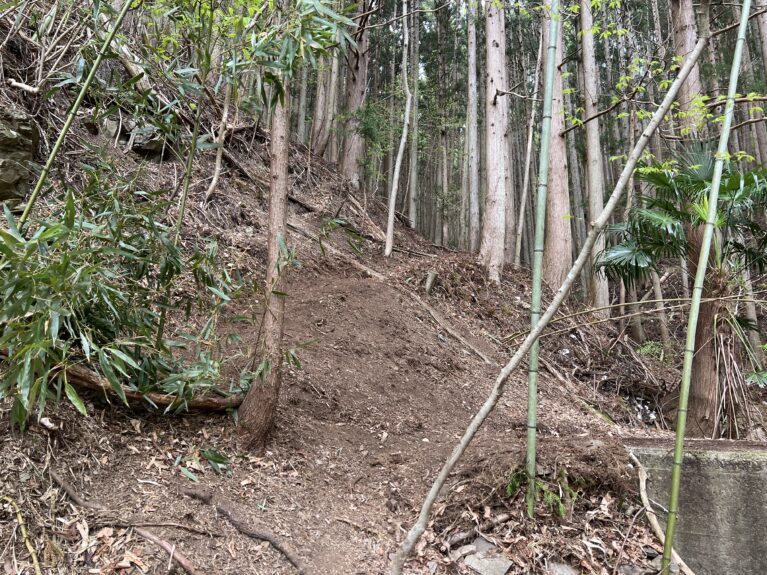
April 22, 2025
Summary
Through this on-site training session in Ogatsu Town, Ishinomaki City, a path steeped in local history—once the route to the former Funakoshi Junior High School—has been revitalized as a new hiking trail.
I feel that every single discussion—such as “how much of the fallen trees should we remove?”—embodies the essence of “environmentally conscious maintenance,” which aims to maximize the joy of walking while minimizing the impact on nature.Working side by side with the maintenance leaders and local residents who participated, we put in the hard work to transform this section into a safe and pleasant trail—one that is sure to become a new attraction for Ogatsu in the years to come.
The Michinoku Trail Club will continue to pass on the stories of our region to the next generation and to create trails where hikers and nature can coexist. We would like to express our sincere gratitude to everyone who helped with the trail maintenance.
Come experience the changes for yourself on the newly renovated trails of the Funakoshi Peninsula!

Article by: Ryota Matsukawa