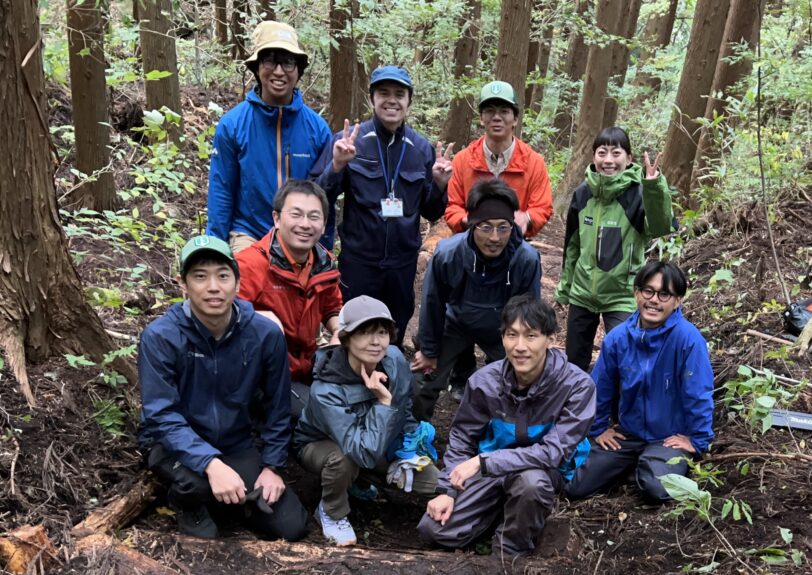

Trail Maintenance Field Training Session Held at Mt. Kakamigahara
We held a three-day hands-on training session on trail maintenance at Mt. Hashikami from October 16 to 18.
(Part of activities funded by the Global Environment Fund).
1. What Is the On-Site Trail Maintenance Training Workshop?
Due to repeated damage from heavy rains and typhoons in recent years, as well as overuse, Japan’s hiking trails have been deteriorating, and the Michinoku Coastal Trail is no exception; landslides and gullies have already been confirmed in some sections.
Against this backdrop, the Michinoku Trail Club has begun full-scale efforts this fiscal year to preserve the environment while maintaining the Michinoku Coastal Trail in a condition that makes it easy to walk.
In order to preserve the environment, conservation efforts must outpace the rate at which the environment is being degraded; however, current efforts are not yet sufficient. To further advance conservation efforts, we need the support of many people who understand and cooperate with these efforts.
This time, in order to create a framework that would allow many people to participate in conservation activities along the Michinoku Coastal Trail, we held a hands-on trail maintenance workshop aimed at training conservation leaders.
2. The Current Situation at Mt. Kakamigatake
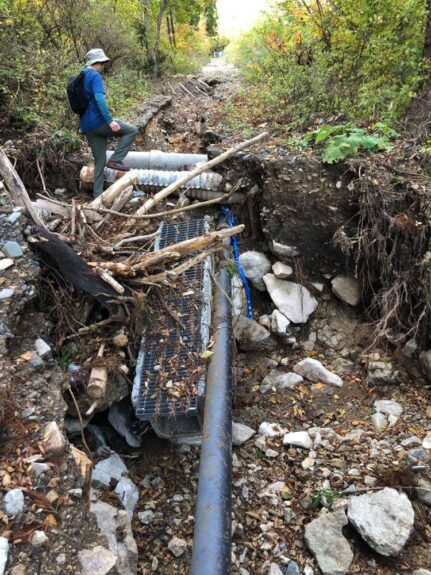
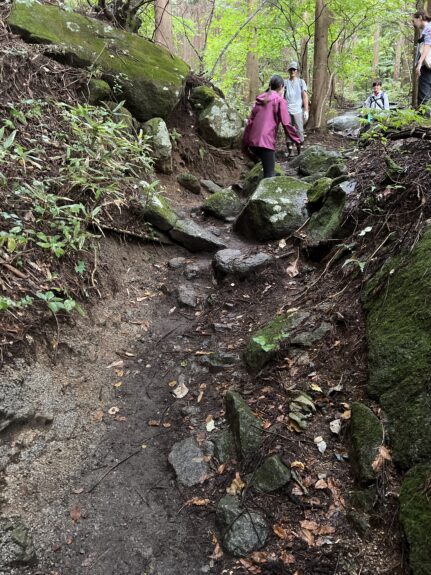
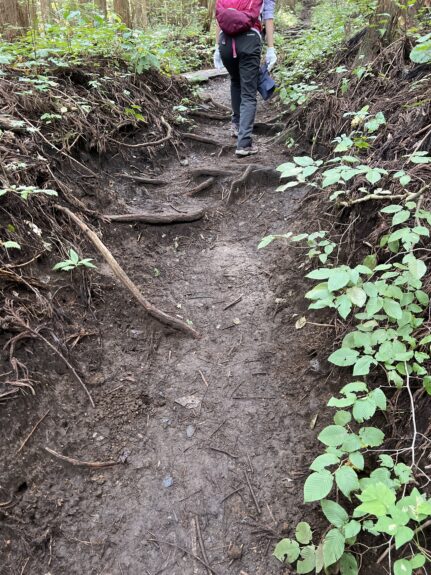
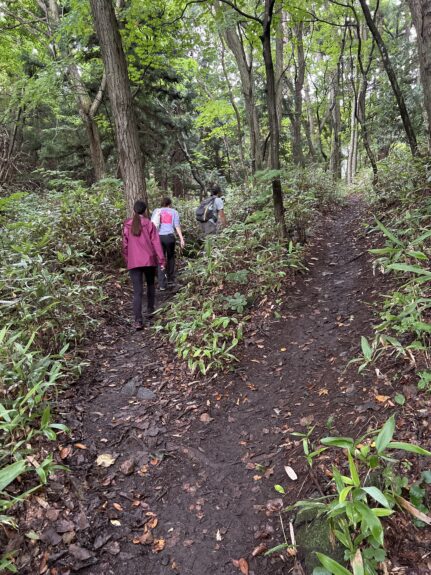
Mount Hashikami is a mountain located in Hashikami Town, Aomori Prefecture, with an elevation of approximately 740 meters. It is the highest point along the Michinoku Coastal Trail and attracts many hikers, including locals. Consequently, there are many areas where the ground surface has been eroded due to foot traffic, and preliminary surveys confirmed the presence of several gullies and sections where the trail had split into multiple paths.
Since Mount Hashikami is frequently visited by hikers, and it was anticipated that the site would continue to deteriorate if the current situation were left unaddressed, we chose Mount Hashikami as the location for this training session.
3. Overview of the “Mount Kakamigahara Trail Maintenance Field Training Session”
- Date and Time: Monday, October 16, 2023 – Wednesday, October 18, 2023
- Location: Hakaue-dake—hiking trail near Shirushi-daira
- Organized by: NPO Michinoku Trail Club
- Instructors: Members of the Hokuto Mountain Rescue Team (Hokuto City, Yamanashi Prefecture)
- Participants: Three members of the satellite facility (leaders), representatives from the Hachinohe Nature Conservation Office, and residents of Hashikami Town
- Details:
[Day 1] Nature Observation Session
[Day 2] Sharing Ideas, Work, and Reflection
[Day 3] Trail Survey (Toshisa Coast)
4. Details of the “Mount Kakamigata Trail Maintenance Field Training Session”
We invited members of the Hokuto Mountain Conservation Corps to serve as instructors. In addition, three members from our satellite facility participated as leaders, and representatives from the Hachinohe Nature Conservation Office and Hashikami Town joined us as observers.From the Michinoku Trail Club, three of us participated—Secretary General Aizawa, Mori from the Trail Operations Division, and myself—for a total of 11 people working on the project.
[Day 1]
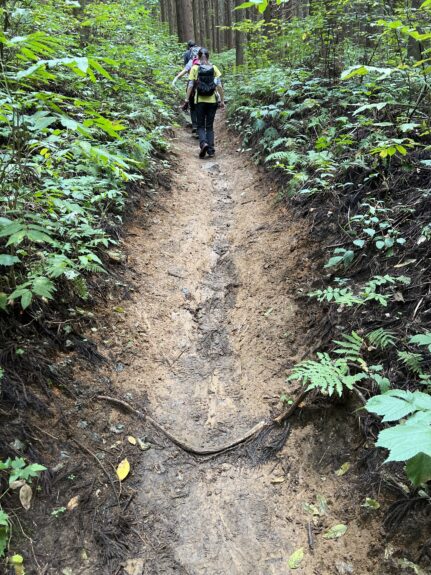
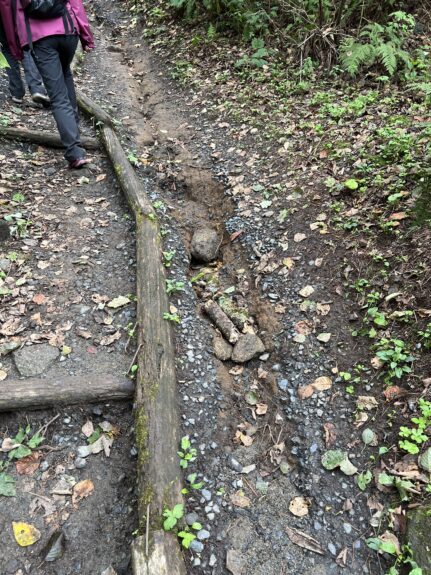
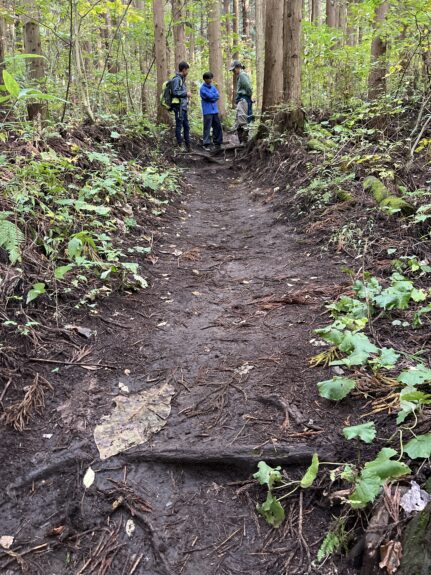
On the first day, we held a nature observation session to learn about the causes of trail erosion and how it negatively impacts the natural environment. One common pattern of trail erosion occurs when hiker traffic prevents vegetation from growing, leaving the ground bare; water then collects on the trail, forming a channel that carries away soil and sediment. By observing actual hiking trails, we were able to learn about this mechanism.
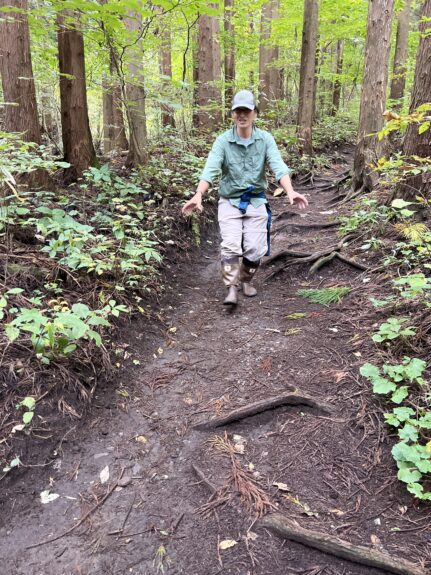
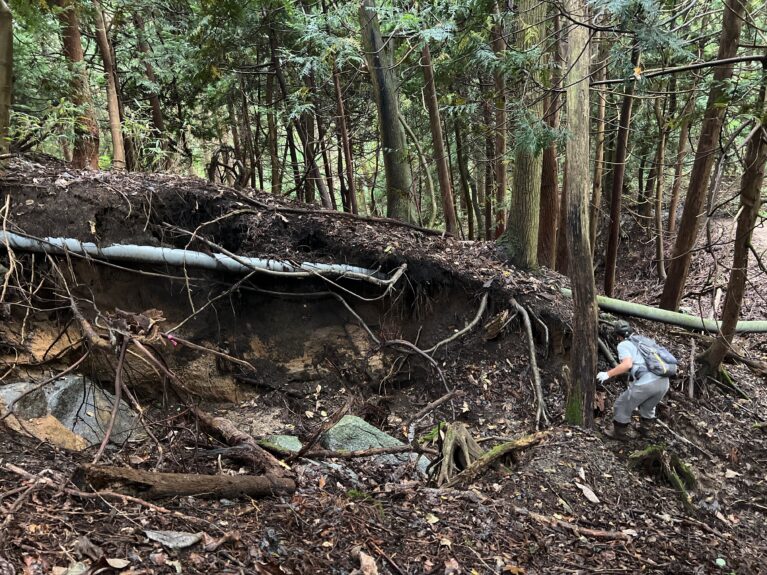
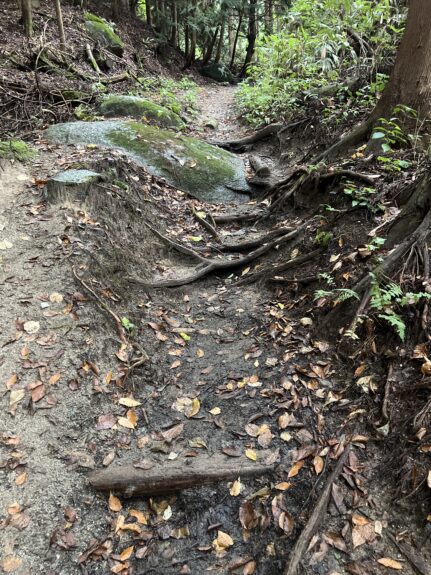
We’ve decided that the area to be restored on the second day will be this spot, where soil has eroded away and tree roots are now exposed at the surface.
Judging by the condition of the surrounding ground, it appears there used to be enough soil to completely cover the tree roots. I wonder how much of the area we’ll be able to restore during the second day’s conservation efforts.
[Day 2]
On this day, we’ll actually put together the choreography.
First, we’ll use thin branches to help everyone visualize the final result.
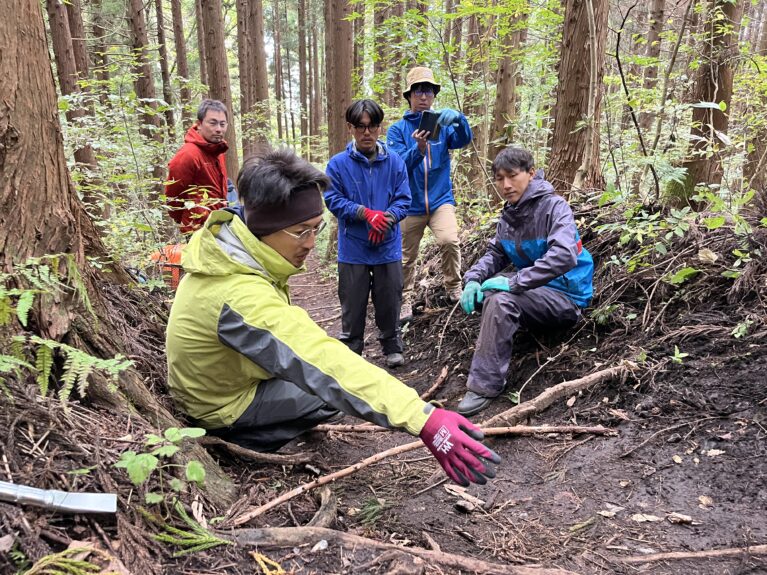
Check the number and length of logs needed, then cut down the fallen trees to prepare the logs.
Place logs at the base of the trail to mark the positions of the steps.
Next, fill in the spaces between the steps with branches, dead leaves, and soil, in that order.
For detailed instructions on how to assemble the steps, please check my blog post from when I participated in the conservation workshop hosted by the Hokuto Mountain Guardians.
Report on Participation in the “Hiking Trail Conservation Workshop”
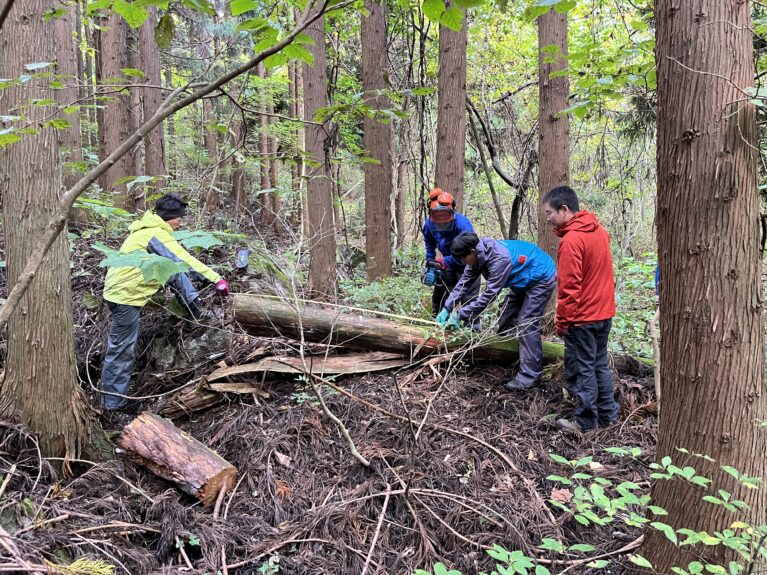
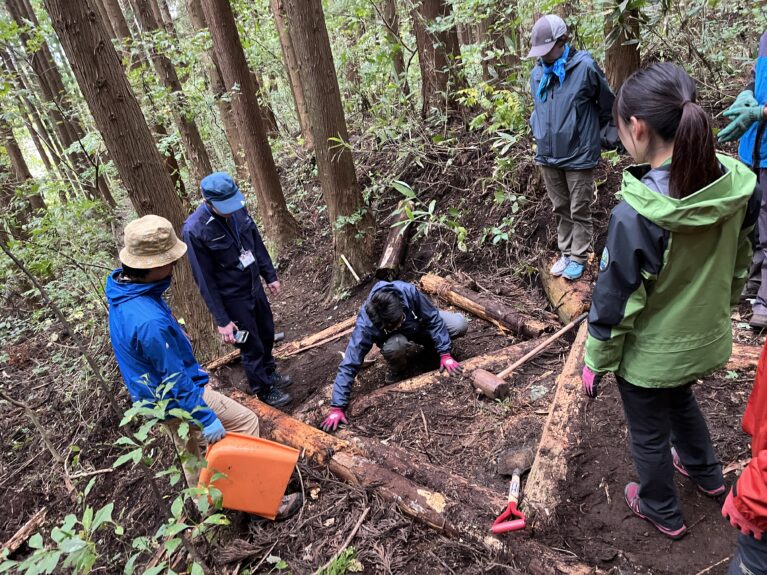
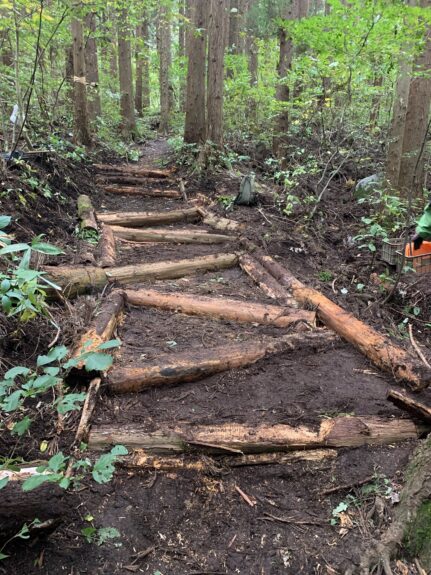
We spent about four hours maintaining a hiking trail that was about 10 meters long.
As the project went on, everyone got the hang of it, and it turned out more smoothly than I expected.
[Day 3]
On the third day, we conducted a trail survey along the Tanezashi Coast.
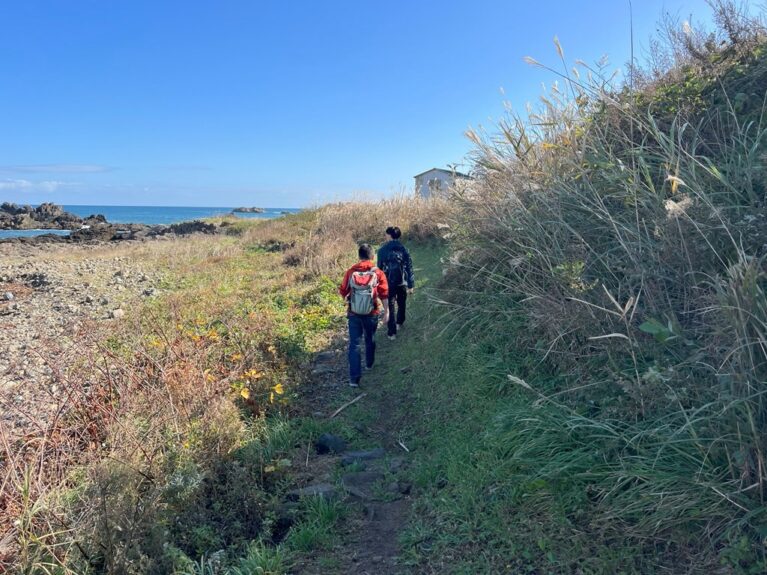
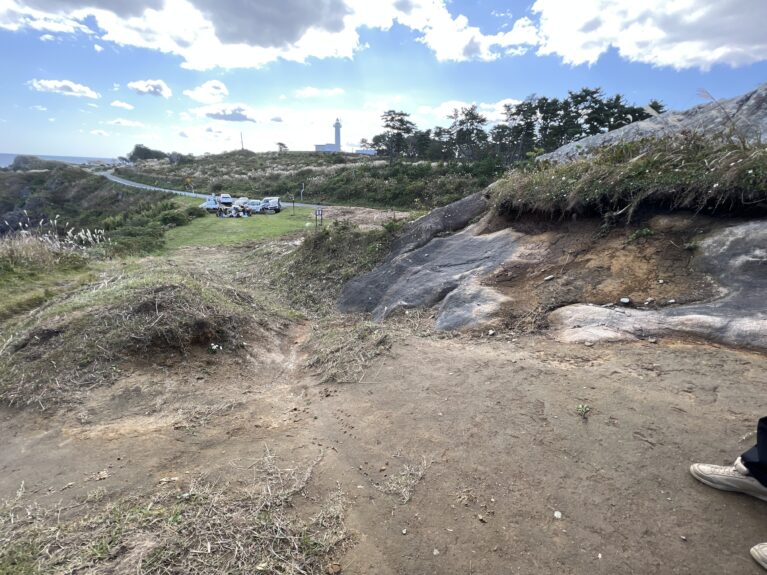
The trail was generally well-maintained, but there was one area of concern. Because many people have been walking off the trail, the ground has become increasingly bare, and soil is eroding away. It’s said to be only a matter of time before the remaining soil and vegetation on the rock at the far right collapse. First and foremost, we need to set up a barrier to prevent people from straying off the trail.
Reflections and Future Outlook
Through this training session, participants shared comments such as, “My perspective on hiking trails has changed,” “I’d like to try this in my local community,” and “It was fun to take part in the trail maintenance.”
When I visited conservation activities organized by the Shinetsu Trail Club (Iiyama City, Nagano Prefecture) and the Hokuto Mountain Guardians (Hokuto City, Yamanashi Prefecture), I saw many hikers—some traveling from far away—participating and clearly enjoying themselves. At that time, I felt that the number of hikers and local residents who want to participate in such conservation activities is definitely on the rise.
Not only hiking, but all outdoor activities in nature constantly present the challenge of striking a balance between use and conservation.We believe that for the Michinoku Coastal Trail to remain a beloved trail for years to come, our vital mission is to promote its use while simultaneously advancing the conservation of the trail itself and the surrounding environment. The Michinoku Trail Club is currently developing a system that will allow many people to get involved in conservation activities. Please continue to check back for updates on our activities.
The next hands-on trail maintenance workshop is scheduled to take place in Kamaishi City in December.